Guanethidine: Difference between revisions
CSV import |
CSV import |
||
| Line 31: | Line 31: | ||
{{medicine-stub}} | {{medicine-stub}} | ||
{{No image}} | {{No image}} | ||
<gallery> | |||
File:Guanethidine.svg|Guanethidine chemical structure | |||
File:Guanethidine 3D ball.png|Guanethidine 3D ball model | |||
</gallery> | |||
Revision as of 01:09, 20 February 2025
Guanethidine is a pharmacological agent that is primarily used in the management of hypertension. It belongs to the class of drugs known as sympatholytics, which work by inhibiting the release of norepinephrine from nerve endings, thereby reducing the activity of the sympathetic nervous system.
Mechanism of Action
Guanethidine works by replacing norepinephrine in the storage vesicles of sympathetic nerve endings. This results in a depletion of norepinephrine stores and a reduction in the transmission of sympathetic impulses. The overall effect is a decrease in blood pressure.
Pharmacokinetics
After oral administration, guanethidine is slowly absorbed from the gastrointestinal tract. It is not metabolized and is excreted unchanged in the urine. The onset of action is slow, and the duration of action is long, making it suitable for once-daily dosing.
Clinical Uses
Guanethidine is used in the treatment of moderate to severe hypertension. It may be used alone or in combination with other antihypertensive agents. It is also used in the management of pheochromocytoma, a rare tumor of the adrenal glands that causes excessive release of catecholamines.
Side Effects
Common side effects of guanethidine include orthostatic hypotension, diarrhea, nasal congestion, and sexual dysfunction. Rare but serious side effects include cardiac arrhythmias and severe hypotension.
Contraindications
Guanethidine is contraindicated in patients with pheochromocytoma, heart failure, and severe coronary artery disease. It should be used with caution in patients with renal impairment due to the risk of accumulation and toxicity.
Drug Interactions
Guanethidine can interact with a number of other medications, including tricyclic antidepressants, monoamine oxidase inhibitors, and sympathomimetic drugs. These interactions can lead to an increase in blood pressure and should be avoided.

-
 Guanethidine chemical structure
 -
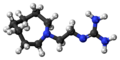 Guanethidine 3D ball model


