Testosterone: Difference between revisions
No edit summary |
CSV import |
||
| Line 24: | Line 24: | ||
[[Category:Endocrinology]] | [[Category:Endocrinology]] | ||
[[Category:Sex hormones]] | [[Category:Sex hormones]] | ||
<gallery> | |||
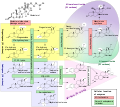
File:Steroidogenesis.svg|Testosterone | |||
File:Hypothalamus pituitary testicles axis.png|Testosterone | |||
File:Dimeric SHBG.png|Testosterone | |||
File:Method for determining testosterone.png|Testosterone | |||
File:Lavoslav Ružićka 1939.jpg|Testosterone | |||
</gallery> | |||
Revision as of 01:07, 20 February 2025
Testosterone is a steroid hormone from the androgen group and is found in humans and other vertebrates. In humans, testosterone is primarily secreted by the testes in males and, to a lesser extent, by the ovaries in females. Small amounts are also secreted by the adrenal glands.
Functions
Testosterone is the principal male sex hormone and an anabolic steroid. In males, testosterone plays a key role in the development of male reproductive tissues such as the testis and prostate, as well as promoting secondary sexual characteristics such as increased muscle and bone mass, and the growth of body hair. In addition, testosterone is essential for health and well-being, and for the prevention of osteoporosis.
Medical Uses
Testosterone is used as a medication to treat male hypogonadism and certain types of breast cancer. It is also used in hormone replacement therapy for transgender men. Testosterone is available as a prescription drug in several forms, including injectable solutions, transdermal patches, and topical gels.
Side Effects
Common side effects of testosterone therapy include acne, oily skin, hair loss, and increased red blood cell count. More serious side effects can include cardiovascular disease, liver damage, and infertility.
See Also
External Links
-
 Testosterone
 -
 Testosterone
 -
 Testosterone
 -
 Testosterone
 -
 Testosterone


