Sfenj: Difference between revisions
CSV import |
CSV import |
||
| Line 22: | Line 22: | ||
[[Category:Israeli cuisine]] | [[Category:Israeli cuisine]] | ||
{{food-stub}} | {{food-stub}} | ||
<gallery> | |||
File:Sfenj in Marrakesh Morocco.jpg|Sfenj in Marrakesh, Morocco | |||
File:السفنز الليبي.jpg|Sfenj | |||
File:Homemade sfenj coated with honey.jpg|Homemade sfenj coated with honey | |||
File:Sfenj in Essaouira Morocco.jpg|Sfenj in Essaouira, Morocco | |||
File:Plats Algeriens (1) sfenj.jpg|Sfenj | |||
File:Khfaf de Kabylie.jpg|Khfaf de Kabylie | |||
File:Sfenj sprinkled with sugar and served on a plate.jpg|Sfenj sprinkled with sugar and served on a plate | |||
</gallery> | |||
Latest revision as of 01:06, 20 February 2025
Sfenj is a traditional North African doughnut that is especially popular in Morocco, Algeria, and Tunisia. It is also commonly consumed in Israel by the Mizrahi Jewish community. Sfenj is typically eaten for breakfast or during Ramadan.
Etymology[edit]
The word "Sfenj" comes from the Arabic word "Isfenj", which means "sponge". This is likely due to the doughnut's spongy texture when it is cooked.
Preparation[edit]
Sfenj is made from a sticky, unsweetened yeast dough. The dough is shaped into a ring and then deep-fried until it becomes golden and crispy. It is often served hot and dusted with sugar, although it can also be eaten plain or soaked in honey. Unlike many other types of doughnuts, Sfenj is not typically filled with any kind of jam or cream.
Cultural Significance[edit]
In North Africa, Sfenj is often sold by street vendors and is a popular choice for breakfast or for breaking the fast during Ramadan. In Israel, it is commonly eaten during the Hanukkah holiday, as it is customary to eat fried foods during this time to commemorate the miracle of the oil in the Second Temple.
See Also[edit]

-
 Sfenj in Marrakesh, Morocco
 -
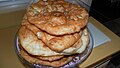 Sfenj
Sfenj -
 Homemade sfenj coated with honey
 -
 Sfenj in Essaouira, Morocco
 -
 Sfenj
Sfenj -
 Khfaf de Kabylie
 -
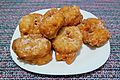 Sfenj sprinkled with sugar and served on a plate


_sfenj.jpg)


