Cutaneous myxoma: Difference between revisions
CSV import |
CSV import |
||
| Line 29: | Line 29: | ||
{{Soft tissue tumors}} | {{Soft tissue tumors}} | ||
{{Medicine-stub}} | {{Medicine-stub}} | ||
<gallery> | |||
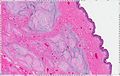
File:CutaneousMyxoma.jpg|Cutaneous myxoma | |||
</gallery> | |||
Revision as of 00:59, 20 February 2025
Cutaneous Myxoma is a rare, benign soft tissue tumor that originates in the skin. It is part of a group of tumors known as myxomas, which are characterized by the presence of mucoid (myxoid) connective tissue. Cutaneous myxomas are most commonly found in adults and can occur anywhere on the body, but they have a predilection for the head, neck, and extremities.
Etiology and Pathogenesis
The exact cause of cutaneous myxoma is not well understood. It is believed to be sporadic in most cases, although some may be associated with genetic syndromes such as Carney Complex, a condition characterized by multiple myxomas, skin pigmentation abnormalities, and endocrine overactivity. The pathogenesis involves the proliferation of stellate or spindle-shaped cells within a myxoid stroma, which is rich in hyaluronic acid.
Clinical Features
Cutaneous myxoma presents as a solitary, slow-growing, painless, and soft to rubbery nodule. The overlying skin is usually normal in appearance. Lesions are typically less than 2 cm in diameter but can vary in size. Due to their benign nature, cutaneous myxomas do not metastasize but can recur if not completely excised.
Diagnosis
The diagnosis of cutaneous myxoma is primarily based on histopathological examination of the excised lesion. Imaging studies are not typically required but may be used to assess the extent of larger or deeper lesions. Histologically, cutaneous myxomas are characterized by a loose, myxoid stroma with scattered spindle-shaped cells and a variable amount of collagen fibers.
Treatment
The treatment of choice for cutaneous myxoma is complete surgical excision with clear margins to prevent recurrence. There is no role for chemotherapy or radiation therapy in the treatment of these benign tumors. Follow-up is recommended to monitor for recurrence, especially in cases associated with syndromes that predispose to multiple myxomas.
Prognosis
The prognosis for cutaneous myxoma is excellent, with complete excision being curative in most cases. Recurrence is rare but can occur, particularly if the excision is incomplete.
Epidemiology
Cutaneous myxoma is a rare condition, and its exact incidence is unknown. It can occur at any age but is most commonly diagnosed in adults. There is no clear gender predilection.
Differential Diagnosis
The differential diagnosis for cutaneous myxoma includes other soft tissue tumors such as neurofibroma, lipoma, and dermatofibroma. Histopathological examination is essential for accurate diagnosis.
| Soft Tissue Tumors | ||||||||||
|---|---|---|---|---|---|---|---|---|---|---|
This soft tissue tumor related article is a stub.
|
 | This medical article is a stub. You can help Wikipedia by adding missing information. |
-
 Cutaneous myxoma

