Bulgarian cuisine: Difference between revisions
CSV import |
No edit summary |
||
| Line 1: | Line 1: | ||
{{Short description|An overview of Bulgarian cuisine, its history, and traditional dishes}} | {{Short description|An overview of Bulgarian cuisine, its history, and traditional dishes}} | ||
[[File:Banitsa.jpg|thumb|left|Banitsa, a traditional Bulgarian pastry]] | |||
[[Bulgarian cuisine]] is a representative of the culinary traditions of the [[Bulgaria|Bulgarian]] people. It is characterized by a variety of fresh ingredients, hearty dishes, and a blend of flavors that reflect the country's diverse cultural influences. The cuisine is known for its use of fresh vegetables, dairy products, and meats, often seasoned with herbs and spices. | [[Bulgarian cuisine]] is a representative of the culinary traditions of the [[Bulgaria|Bulgarian]] people. It is characterized by a variety of fresh ingredients, hearty dishes, and a blend of flavors that reflect the country's diverse cultural influences. The cuisine is known for its use of fresh vegetables, dairy products, and meats, often seasoned with herbs and spices. | ||
| Line 17: | Line 16: | ||
===Soups=== | ===Soups=== | ||
[[Tarator]] is a popular cold soup made with yogurt, cucumbers, garlic, dill, and walnuts. It is especially refreshing during the hot summer months. | [[Tarator]] is a popular cold soup made with yogurt, cucumbers, garlic, dill, and walnuts. It is especially refreshing during the hot summer months. | ||
===Main Courses=== | ===Main Courses=== | ||
[[Kavarma]] is a traditional Bulgarian stew made with pork or chicken, onions, peppers, and tomatoes, often cooked in a clay pot. Another popular dish is [[moussaka]], a layered casserole of potatoes, minced meat, and béchamel sauce. | [[Kavarma]] is a traditional Bulgarian stew made with pork or chicken, onions, peppers, and tomatoes, often cooked in a clay pot. Another popular dish is [[moussaka]], a layered casserole of potatoes, minced meat, and béchamel sauce. | ||
===Pastries=== | ===Pastries=== | ||
[[Banitsa]] is a traditional Bulgarian pastry made with layers of filo dough filled with a mixture of eggs, yogurt, and sirene cheese. It is often enjoyed as a breakfast dish or snack. | [[Banitsa]] is a traditional Bulgarian pastry made with layers of filo dough filled with a mixture of eggs, yogurt, and sirene cheese. It is often enjoyed as a breakfast dish or snack. | ||
==Beverages== | ==Beverages== | ||
Bulgarian cuisine also includes a variety of beverages. [[Rakia]], a fruit brandy, is a popular alcoholic drink, often served as an aperitif. [[Boza]], a fermented beverage made from grains, is another traditional drink. | Bulgarian cuisine also includes a variety of beverages. [[Rakia]], a fruit brandy, is a popular alcoholic drink, often served as an aperitif. [[Boza]], a fermented beverage made from grains, is another traditional drink. | ||
== Gallery == | |||
<gallery> | |||
File:Kebap1027.JPG|Bulgarian cuisine | |||
File:Sarmi.jpg|Bulgarian cuisine | |||
File:Lukanka.jpg|Bulgarian cuisine | |||
File:TaratorBg.jpg|Bulgarian cuisine | |||
File:Meat_ball_soup.JPG|Bulgarian cuisine | |||
File:Shkembe-chorba.jpg|Bulgarian cuisine | |||
File:Arima_Grand_Hotel09s4s4272.jpg|Bulgarian cuisine | |||
File:Marouli_Salata.jpg|Bulgarian cuisine | |||
File:chopska.jpg|Bulgarian cuisine | |||
File:Лутеница.jpg|Bulgarian cuisine | |||
File:Bulgarian_barbecue_from_the_Rhodopes.jpg|Bulgarian cuisine | |||
File:Cheverme-02.JPG|Bulgarian cuisine | |||
</gallery> | |||
==Related pages== | ==Related pages== | ||
Latest revision as of 02:16, 19 February 2025
An overview of Bulgarian cuisine, its history, and traditional dishes

Bulgarian cuisine is a representative of the culinary traditions of the Bulgarian people. It is characterized by a variety of fresh ingredients, hearty dishes, and a blend of flavors that reflect the country's diverse cultural influences. The cuisine is known for its use of fresh vegetables, dairy products, and meats, often seasoned with herbs and spices.
History[edit]
The history of Bulgarian cuisine is deeply intertwined with the country's geographical location and historical events. Situated at the crossroads of Europe and Asia, Bulgaria has been influenced by various cultures, including Greek, Turkish, and Slavic culinary traditions. The Ottoman Empire's long rule over Bulgaria introduced many dishes and cooking techniques that are still prevalent today.
Ingredients[edit]
Bulgarian cuisine makes extensive use of fresh, locally sourced ingredients. Common vegetables include tomatoes, cucumbers, peppers, and eggplants. Dairy products such as yogurt and sirene (a type of white cheese) are staples in many dishes. Meats such as pork, chicken, and lamb are frequently used, often grilled or stewed.
Traditional Dishes[edit]
Salads[edit]

One of the most famous Bulgarian salads is the Shopska salad, made with tomatoes, cucumbers, onions, peppers, and topped with grated sirene cheese. It is often seasoned with olive oil and vinegar.
Soups[edit]
Tarator is a popular cold soup made with yogurt, cucumbers, garlic, dill, and walnuts. It is especially refreshing during the hot summer months.
Main Courses[edit]
Kavarma is a traditional Bulgarian stew made with pork or chicken, onions, peppers, and tomatoes, often cooked in a clay pot. Another popular dish is moussaka, a layered casserole of potatoes, minced meat, and béchamel sauce.
Pastries[edit]
Banitsa is a traditional Bulgarian pastry made with layers of filo dough filled with a mixture of eggs, yogurt, and sirene cheese. It is often enjoyed as a breakfast dish or snack.
Beverages[edit]
Bulgarian cuisine also includes a variety of beverages. Rakia, a fruit brandy, is a popular alcoholic drink, often served as an aperitif. Boza, a fermented beverage made from grains, is another traditional drink.
Gallery[edit]
-
 Bulgarian cuisine
 -
 Bulgarian cuisine
 -
 Bulgarian cuisine
 -
 Bulgarian cuisine
 -
 Bulgarian cuisine
 -
 Bulgarian cuisine
 -
 Bulgarian cuisine
 -
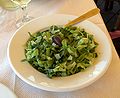 Bulgarian cuisine
 -
 Bulgarian cuisine
 -
 Bulgarian cuisine
 -
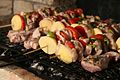 Bulgarian cuisine
 -
 Bulgarian cuisine


