Breadstick: Difference between revisions
CSV import |
No edit summary |
||
| Line 1: | Line 1: | ||
{{Short description|A type of bread originating from Italy}} | {{Short description|A type of bread originating from Italy}} | ||
Breadsticks, also known as grissini, are a type of bread that originated in [[Italy]]. They are typically pencil-sized sticks of crisp, dry bread that are often served as an appetizer in restaurants. Breadsticks can be seasoned with a variety of herbs and spices, such as [[garlic]], [[rosemary]], or [[sesame seeds]]. | Breadsticks, also known as grissini, are a type of bread that originated in [[Italy]]. They are typically pencil-sized sticks of crisp, dry bread that are often served as an appetizer in restaurants. Breadsticks can be seasoned with a variety of herbs and spices, such as [[garlic]], [[rosemary]], or [[sesame seeds]]. | ||
| Line 21: | Line 17: | ||
==Cultural Significance== | ==Cultural Significance== | ||
In Italy, breadsticks are a staple in many households and are often included in meals as a form of [[pane]], or bread. They are also a popular item in Italian restaurants around the world, where they are typically served as a complimentary appetizer. | In Italy, breadsticks are a staple in many households and are often included in meals as a form of [[pane]], or bread. They are also a popular item in Italian restaurants around the world, where they are typically served as a complimentary appetizer. | ||
== Gallery == | |||
<gallery> | |||
File:Grissinistirati.jpg|Grissinistirati | |||
File:2016_1129_Turin_Grissini.jpg|Grissini in Turin | |||
</gallery> | |||
==Related pages== | ==Related pages== | ||
Latest revision as of 01:56, 19 February 2025
A type of bread originating from Italy
Breadsticks, also known as grissini, are a type of bread that originated in Italy. They are typically pencil-sized sticks of crisp, dry bread that are often served as an appetizer in restaurants. Breadsticks can be seasoned with a variety of herbs and spices, such as garlic, rosemary, or sesame seeds.
History[edit]
The origin of breadsticks can be traced back to the region of Piedmont in Italy, specifically to the city of Turin. It is believed that breadsticks were invented in the 17th century by a baker named Antonio Brunero. The story goes that Brunero created breadsticks as a way to help the young Duke of Savoy, Vittorio Amedeo II, who had digestive problems and could not eat regular bread.
Preparation[edit]

Breadsticks are made from a simple dough consisting of flour, water, yeast, and salt. The dough is kneaded and then rolled into thin strips, which are baked until they become crisp. The baking process gives breadsticks their characteristic crunchy texture. Some variations include adding olive oil to the dough for a richer flavor.
Variations[edit]
There are many variations of breadsticks, ranging from the traditional Italian grissini to more modern interpretations. Some breadsticks are soft and chewy, while others are hard and crunchy. In the United States, breadsticks are often served warm and soft, sometimes topped with butter and parmesan cheese.
Culinary Uses[edit]
Breadsticks are commonly served as an appetizer or snack. They are often paired with dips such as hummus, pesto, or marinara sauce. In Italian cuisine, breadsticks are sometimes wrapped with prosciutto or served alongside antipasto platters.
Cultural Significance[edit]
In Italy, breadsticks are a staple in many households and are often included in meals as a form of pane, or bread. They are also a popular item in Italian restaurants around the world, where they are typically served as a complimentary appetizer.
Gallery[edit]
-
 Grissinistirati
 -
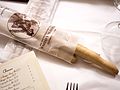 Grissini in Turin


