Amontillado: Difference between revisions
CSV import |
CSV import |
||
| Line 4: | Line 4: | ||
File:Coxsackievirus_infection_on_skin.jpg|Coxsackievirus infection on skin | File:Coxsackievirus_infection_on_skin.jpg|Coxsackievirus infection on skin | ||
</gallery> | </gallery> | ||
==Amontillado== | |||
'''Amontillado''' is a variety of [[sherry]] wine characterized by its unique aging process and flavor profile. Originating from the [[Jerez]] region in [[Spain]], Amontillado is known for its rich, nutty taste and amber color. It is a fortified wine that undergoes a distinctive maturation process, combining both biological and oxidative aging. | |||
===Production=== | |||
Amontillado begins its life as a [[Fino]] sherry, which is aged under a layer of [[flor]] yeast in a process known as biological aging. This initial stage typically lasts for about three to eight years. During this time, the flor yeast protects the wine from oxidation, imparting delicate flavors and a pale color. | |||
After the biological aging phase, the flor yeast is allowed to die off, either naturally or by fortifying the wine with additional [[brandy]] to increase its alcohol content. This marks the beginning of the oxidative aging process, where the wine is exposed to air, leading to the development of deeper flavors and a darker color. The oxidative aging can last for several more years, resulting in the complex and nuanced profile that Amontillado is known for. | |||
===Flavor Profile=== | |||
Amontillado sherry is celebrated for its unique combination of flavors. It retains some of the crisp, dry characteristics of Fino, while also exhibiting the richer, nuttier notes typical of oxidative aging. Common tasting notes include hazelnuts, almonds, and a hint of dried fruit. The wine is typically dry, although sweeter versions can be found. | |||
===Serving Suggestions=== | |||
Amontillado is traditionally served slightly chilled and is often enjoyed as an [[aperitif]]. It pairs well with a variety of foods, including [[tapas]], [[cheese]], [[nuts]], and [[charcuterie]]. Its complex flavor profile also makes it a suitable accompaniment to richer dishes, such as [[game meats]] and [[mushroom]]-based recipes. | |||
==Related Pages== | |||
* [[Sherry]] | |||
* [[Fino]] | |||
* [[Oloroso]] | |||
* [[Jerez]] | |||
* [[Fortified wine]] | |||
{{Sherry}} | |||
[[Category:Sherry]] | |||
[[Category:Spanish wine]] | |||
[[Category:Fortified wine]] | |||
Latest revision as of 00:42, 19 February 2025
-
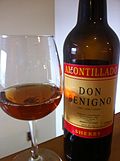 Amontillado sherry
 -
 Del Duque Amontillado Sherry
 -
 Coxsackievirus infection on skin


Amontillado[edit]
Amontillado is a variety of sherry wine characterized by its unique aging process and flavor profile. Originating from the Jerez region in Spain, Amontillado is known for its rich, nutty taste and amber color. It is a fortified wine that undergoes a distinctive maturation process, combining both biological and oxidative aging.
Production[edit]
Amontillado begins its life as a Fino sherry, which is aged under a layer of flor yeast in a process known as biological aging. This initial stage typically lasts for about three to eight years. During this time, the flor yeast protects the wine from oxidation, imparting delicate flavors and a pale color.
After the biological aging phase, the flor yeast is allowed to die off, either naturally or by fortifying the wine with additional brandy to increase its alcohol content. This marks the beginning of the oxidative aging process, where the wine is exposed to air, leading to the development of deeper flavors and a darker color. The oxidative aging can last for several more years, resulting in the complex and nuanced profile that Amontillado is known for.
Flavor Profile[edit]
Amontillado sherry is celebrated for its unique combination of flavors. It retains some of the crisp, dry characteristics of Fino, while also exhibiting the richer, nuttier notes typical of oxidative aging. Common tasting notes include hazelnuts, almonds, and a hint of dried fruit. The wine is typically dry, although sweeter versions can be found.
Serving Suggestions[edit]
Amontillado is traditionally served slightly chilled and is often enjoyed as an aperitif. It pairs well with a variety of foods, including tapas, cheese, nuts, and charcuterie. Its complex flavor profile also makes it a suitable accompaniment to richer dishes, such as game meats and mushroom-based recipes.
