Alternative complement pathway: Difference between revisions
CSV import |
CSV import |
||
| Line 3: | Line 3: | ||
File:Droga_alternatywna.png|Alternative complement pathway | File:Droga_alternatywna.png|Alternative complement pathway | ||
</gallery> | </gallery> | ||
==Alternative Complement Pathway== | |||
The '''alternative complement pathway''' is one of the three pathways that activate the [[complement system]], which is a crucial part of the [[immune system]]. Unlike the [[classical complement pathway]], which is activated by [[antigen-antibody complexes]], the alternative pathway can be activated on microbial surfaces in the absence of antibodies. This pathway plays a vital role in the innate immune response by enhancing the ability of antibodies and phagocytic cells to clear pathogens and damaged cells, promote inflammation, and attack the pathogen's cell membrane. | |||
===Activation=== | |||
The alternative complement pathway is continuously active at a low level due to the spontaneous hydrolysis of the thioester bond in the complement component [[C3 (complement)|C3]], a process known as "tickover." This hydrolysis generates C3(H2O), which can bind to factor B, allowing it to be cleaved by factor D into Ba and Bb. The Bb fragment remains bound to C3(H2O), forming the fluid-phase C3 convertase, C3(H2O)Bb. | |||
When C3b is deposited on a pathogen surface, it can bind factor B, which is then cleaved by factor D to form the surface-bound C3 convertase, C3bBb. This convertase is stabilized by properdin, a positive regulator of the alternative pathway, and can cleave additional C3 molecules into C3a and C3b, amplifying the response. | |||
===Regulation=== | |||
The alternative pathway is tightly regulated to prevent damage to host tissues. Regulatory proteins such as [[factor H]], [[factor I]], and [[decay-accelerating factor]] (DAF) ensure that the complement system is activated only on pathogen surfaces. Factor H competes with factor B for binding to C3b and accelerates the decay of the C3 convertase. Factor I cleaves C3b into inactive fragments in the presence of cofactors like factor H and membrane cofactor protein (MCP). | |||
===Functions=== | |||
The alternative complement pathway contributes to the immune response in several ways: | |||
* '''Opsonization''': C3b acts as an opsonin, marking pathogens for phagocytosis by [[macrophages]] and [[neutrophils]]. | |||
* '''Cell lysis''': The formation of the [[membrane attack complex]] (MAC) leads to the lysis of pathogen cells. | |||
* '''Inflammation''': The anaphylatoxins C3a and C5a, generated during complement activation, promote inflammation by recruiting immune cells to the site of infection and increasing vascular permeability. | |||
==Related Pages== | |||
* [[Complement system]] | |||
* [[Classical complement pathway]] | |||
* [[Lectin pathway]] | |||
* [[Membrane attack complex]] | |||
* [[Opsonization]] | |||
{{Immunology}} | |||
[[Category:Immunology]] | |||
[[Category:Complement system]] | |||
Latest revision as of 00:35, 19 February 2025
-
 Diagram of the complement pathway
 -
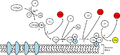 Alternative complement pathway


Alternative Complement Pathway[edit]
The alternative complement pathway is one of the three pathways that activate the complement system, which is a crucial part of the immune system. Unlike the classical complement pathway, which is activated by antigen-antibody complexes, the alternative pathway can be activated on microbial surfaces in the absence of antibodies. This pathway plays a vital role in the innate immune response by enhancing the ability of antibodies and phagocytic cells to clear pathogens and damaged cells, promote inflammation, and attack the pathogen's cell membrane.
Activation[edit]
The alternative complement pathway is continuously active at a low level due to the spontaneous hydrolysis of the thioester bond in the complement component C3, a process known as "tickover." This hydrolysis generates C3(H2O), which can bind to factor B, allowing it to be cleaved by factor D into Ba and Bb. The Bb fragment remains bound to C3(H2O), forming the fluid-phase C3 convertase, C3(H2O)Bb.
When C3b is deposited on a pathogen surface, it can bind factor B, which is then cleaved by factor D to form the surface-bound C3 convertase, C3bBb. This convertase is stabilized by properdin, a positive regulator of the alternative pathway, and can cleave additional C3 molecules into C3a and C3b, amplifying the response.
Regulation[edit]
The alternative pathway is tightly regulated to prevent damage to host tissues. Regulatory proteins such as factor H, factor I, and decay-accelerating factor (DAF) ensure that the complement system is activated only on pathogen surfaces. Factor H competes with factor B for binding to C3b and accelerates the decay of the C3 convertase. Factor I cleaves C3b into inactive fragments in the presence of cofactors like factor H and membrane cofactor protein (MCP).
Functions[edit]
The alternative complement pathway contributes to the immune response in several ways:
- Opsonization: C3b acts as an opsonin, marking pathogens for phagocytosis by macrophages and neutrophils.
- Cell lysis: The formation of the membrane attack complex (MAC) leads to the lysis of pathogen cells.
- Inflammation: The anaphylatoxins C3a and C5a, generated during complement activation, promote inflammation by recruiting immune cells to the site of infection and increasing vascular permeability.
Related Pages[edit]
| Immunology | ||||||||||
|---|---|---|---|---|---|---|---|---|---|---|
This immunology-related article is a stub.
|
