Complement membrane attack complex
Complement membrane attack complex (MAC) is a structure typically formed on the surface of pathogen cells as a result of the activation of the complement system, a part of the immune system that enhances the ability of antibodies and phagocytic cells to clear microbes and damaged cells from an organism. The MAC is one of the final products of the complement system and is designed to disrupt the phospholipid bilayer of cells, leading to cell lysis and death.
Formation[edit]
The formation of the MAC begins with the cleavage of C5 into C5a and C5b by the C5-convertase. C5b binds to C6 to form a C5b-6 complex, which then binds to C7. This C5b-7 complex is able to insert into the phospholipid bilayer, where it acts as a receptor for a C8 molecule. The C5b-8 complex can then interact with C9 molecules to form the MAC. The MAC is a cylindrical structure that creates a pore in the membrane of the target cell, disrupting the cell's integrity and leading to cell lysis.
Function[edit]
The primary function of the MAC is to form a pore in the membrane of pathogenic cells, leading to cell lysis and death. This is a key mechanism by which the immune system can eliminate pathogenic cells. The MAC can also stimulate cells to release inflammatory cytokines, which can recruit additional immune cells to the site of infection.
Regulation[edit]
The formation and activity of the MAC is tightly regulated by several proteins, including CD59, which can prevent the incorporation of C9 into the MAC, and Clusterin and Vitronectin, which can inhibit the MAC at various stages of its formation.
Clinical significance[edit]
Defects in the formation or regulation of the MAC can lead to various diseases. For example, paroxysmal nocturnal hemoglobinuria is a disease characterized by the absence of CD59 on red blood cells, leading to increased lysis by the MAC. Conversely, some pathogens have evolved mechanisms to evade the MAC, contributing to their virulence.
 | This immunology article is a stub. You can help WikiMD by expanding the page. |
-
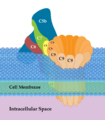 Membrane Attack Complex (Terminal Complement Complex C5b-9)
 -
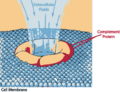 Complement-mediated cell death
 -
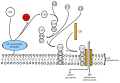 Formation of the Membrane Attack Complex
.png)


Medical Disclaimer: WikiMD is for informational purposes only and is not a substitute for professional medical advice. Content may be inaccurate or outdated and should not be used for diagnosis or treatment. Always consult your healthcare provider for medical decisions. Verify information with trusted sources such as CDC.gov and NIH.gov. By using this site, you agree that WikiMD is not liable for any outcomes related to its content. See full disclaimer.
Credits:Most images are courtesy of Wikimedia commons, and templates, categories Wikipedia, licensed under CC BY SA or similar.
Translate page: - East Asian
中文,
日本,
한국어,
South Asian
हिन्दी,
தமிழ்,
తెలుగు,
Urdu,
ಕನ್ನಡ,
Southeast Asian
Indonesian,
Vietnamese,
Thai,
မြန်မာဘာသာ,
বাংলা
European
español,
Deutsch,
français,
Greek,
português do Brasil,
polski,
română,
русский,
Nederlands,
norsk,
svenska,
suomi,
Italian
Middle Eastern & African
عربى,
Turkish,
Persian,
Hebrew,
Afrikaans,
isiZulu,
Kiswahili,
Other
Bulgarian,
Hungarian,
Czech,
Swedish,
മലയാളം,
मराठी,
ਪੰਜਾਬੀ,
ગુજરાતી,
Portuguese,
Ukrainian

