Pupusa: Difference between revisions
CSV import |
CSV import Tags: mobile edit mobile web edit |
||
| Line 25: | Line 25: | ||
[[Category:Stuffed dishes]] | [[Category:Stuffed dishes]] | ||
{{food-stub}} | {{food-stub}} | ||
<gallery> | |||
File:Pupusas_El_Salvador_Centro_America.JPG|Pupusa | |||
File:Nicaraguan_Cheese_Pupusas.jpg|Nicaraguan Cheese Pupusas | |||
File:2010.05.04.165724_Pupusería_Las_Chinamas_El_Salvador.jpg|Pupusería Las Chinamas, El Salvador | |||
File:Traditional_Pupusas_over_wood_fire.jpg|Traditional Pupusas over wood fire | |||
File:Plain_pupusas_revueltas.jpg|Plain pupusas revueltas | |||
File:Pupusas_by_Roland_Tanglao.jpg|Pupusas by Roland Tanglao | |||
File:Pupusas,_Salvadoreñas,_para_llevar.jpg|Pupusas, Salvadoreñas, para llevar | |||
File:Sarita's_Pupuseria_-_February_2024_-_Sasrah_Stierch_01.jpg|Sarita's Pupuseria | |||
</gallery> | |||
Latest revision as of 12:09, 18 February 2025
Pupusa is a traditional Salvadoran dish made of a thick, handmade corn tortilla (made using masa) that is usually filled with a blend of the following:
- cheese (queso) (usually a soft cheese called Quesillo found in all Central America)
- cooked pork (chicharrones or chicharrón)
- refried beans (frijoles refritos), or
- loroco (a vine flower bud from Central America).
There are also Pupusas revueltas with mixed ingredients, such as queso (cheese), frijoles (beans),[1] and chicharrón or bacon. Pupusas are typically served with curtido (a pickled cabbage relish, similar to sauerkraut and salsa roja), a type of salsa.
History[edit]
The origins of the pupusa are debated, although its presence in El Salvador has been well documented. The Pipil, an indigenous tribe who lived in the territory now known as El Salvador, are often credited with the creation of the pupusa. The word "pupusa" derives from the Pipil language, which was spoken by the indigenous people of El Salvador before the Spanish conquest.
Preparation[edit]
The process of making pupusas begins with the dough, made from masa de maíz (a maize (corn) flour), or masa de arroz (a rice flour). The dough is shaped into a ball and a well is made in the center. The fillings are then added, which can include cheese, chicharrón, or refried beans. The dough is then closed around the filling and patted out into a round shape. The pupusa is then cooked on a hot griddle or frying pan, known as a comal, until golden brown on both sides.
Cultural Significance[edit]
In 2005, the Salvadoran legislature declared the Pupusa as the national dish of El Salvador and enacted La Ley de la Pupusa (The Pupusa Law), which mandated the second Sunday of November as National Pupusa Day. Pupusas are now well-known beyond the borders of El Salvador and can be found in many other countries, including the United States, Mexico, and Canada.
See Also[edit]

-
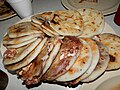 Pupusa
 -
 Nicaraguan Cheese Pupusas
 -
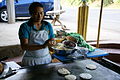 Pupusería Las Chinamas, El Salvador
 -
 Traditional Pupusas over wood fire
 -
 Plain pupusas revueltas
 -
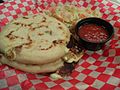 Pupusas by Roland Tanglao
 -
 Pupusas, Salvadoreñas, para llevar
 -
Sarita's Pupuseria


