Colorectal adenoma: Difference between revisions
CSV import Tags: mobile edit mobile web edit |
CSV import |
||
| Line 39: | Line 39: | ||
[[Category:Histopathology]] | [[Category:Histopathology]] | ||
{{Medicine-stub}} | {{Medicine-stub}} | ||
<gallery> | |||
File:Tubulovillous_adenoma.jpg|Tubulovillous adenoma | |||
File:Pie_chart_of_colorectal_polyp_etiologies.png|Pie chart of colorectal polyp etiologies | |||
File:Non-proliferative_versus_proliferative_colonic_crypts.jpg|Non-proliferative versus proliferative colonic crypts | |||
File:Histopathology_of_high-grade_dysplasia_in_tubulovillous_adenoma,_annotated.png|Histopathology of high-grade dysplasia in tubulovillous adenoma, annotated | |||
File:Villous_adenoma1.jpg|Villous adenoma | |||
File:Sessile_serrated_adenoma_3_very_high_mag.jpg|Sessile serrated adenoma, very high magnification | |||
</gallery> | |||
Revision as of 11:32, 18 February 2025
Colorectal adenoma is a type of polyp that is found in the colon or rectum. Colorectal adenomas are considered precancerous conditions, as they can develop into colorectal cancer if left untreated.
Types of Colorectal Adenoma
There are three main types of colorectal adenomas: tubular adenomas, villous adenomas, and tubulovillous adenomas.
- Tubular adenoma is the most common type of colorectal adenoma. It is typically small and has a lower risk of becoming cancerous compared to other types of adenomas.
- Villous adenoma is less common but more likely to become cancerous. It is often larger and has a villous or "finger-like" appearance under the microscope.
- Tubulovillous adenoma is a mix of tubular and villous adenoma. It has an intermediate risk of becoming cancerous.
Risk Factors
Several factors can increase the risk of developing colorectal adenomas. These include age, a history of colorectal adenomas or colorectal cancer, certain genetic syndromes such as Lynch syndrome and Familial adenomatous polyposis, and lifestyle factors such as diet, smoking, and lack of physical activity.
Diagnosis
Colorectal adenomas are often found during a colonoscopy or sigmoidoscopy. If an adenoma is found, it is usually removed and sent to a lab for testing. The lab can confirm whether the polyp is an adenoma and whether it has any signs of cancer.
Treatment
The primary treatment for colorectal adenomas is removal during a colonoscopy or sigmoidoscopy. This is usually done using a procedure called a polypectomy. In some cases, if the adenoma is very large or if there are many adenomas, surgery may be needed.
Prevention
Prevention strategies for colorectal adenomas include regular screening with colonoscopy or sigmoidoscopy, maintaining a healthy diet, regular physical activity, and avoiding smoking.
See Also

-
 Tubulovillous adenoma
 -
 Pie chart of colorectal polyp etiologies
 -
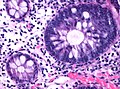 Non-proliferative versus proliferative colonic crypts
 -
 Histopathology of high-grade dysplasia in tubulovillous adenoma, annotated
 -
 Villous adenoma
 -
Sessile serrated adenoma, very high magnification


