Break (work): Difference between revisions
CSV import Tags: mobile edit mobile web edit |
CSV import |
||
| Line 31: | Line 31: | ||
{{employment-stub}} | {{employment-stub}} | ||
{{food-stub}} | {{food-stub}} | ||
<gallery> | |||
File:Two_Men_Taking_a_Break.JPG|Two men taking a break | |||
File:City_Light_employees_on_coffee_break,_1960s.jpg|City Light employees on coffee break, 1960s | |||
File:26._Internationales_Management_Symposium-Helferin_mit_Schild_Break_over-HSGN_028-01097.jpg|International Management Symposium - Break over | |||
File:Waiter_Takes_a_Smoke_Break_-_Canakkale_Clocktower_-_Dardanelles_-_Turkey_(5731104910).jpg|Waiter takes a smoke break | |||
</gallery> | |||
Latest revision as of 10:54, 18 February 2025
Break (work)
A break in the context of work refers to a period of time during which an individual pauses from their work-related tasks. This can be a short-term interruption, such as a lunch break, or a longer-term break, such as a vacation or sabbatical. Breaks are typically used to rest, rejuvenate, and maintain productivity.
Types of Breaks[edit]
There are several types of breaks that are commonly recognized in the workplace:
- Coffee break: A short period of time, typically in the mid-morning or mid-afternoon, during which employees can rest and often consume beverages such as coffee or tea.
- Lunch break: A longer period of time, typically in the middle of the workday, during which employees can eat lunch and rest.
- Vacation: A longer period of time, often one or two weeks, during which an employee is not expected to work. This is typically used for rest and recreation.
- Sabbatical: A long-term break, often lasting several months or a year, during which an employee may pursue personal projects or professional development.
Benefits of Breaks[edit]
Breaks have been shown to have several benefits in the workplace. They can help to prevent burnout, increase productivity, and improve employee morale. Breaks can also provide an opportunity for employees to socialize and build relationships with their colleagues, which can contribute to a positive workplace culture.
Regulations[edit]
In many countries, breaks are regulated by labor laws. These laws may specify the length and frequency of breaks, as well as whether or not they are paid. In some cases, employers may be required to provide certain facilities, such as a break room, for their employees to use during their breaks.
See Also[edit]
This employment related article is a stub. You can help WikiMD by expanding it.

-
 Two men taking a break
 -
 City Light employees on coffee break, 1960s
 -
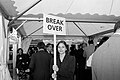 International Management Symposium - Break over
 -
 Waiter takes a smoke break


.jpg)
