Leydig cell tumour: Difference between revisions
CSV import |
CSV import |
||
| Line 28: | Line 28: | ||
[[Category:Endocrinology]] | [[Category:Endocrinology]] | ||
{{Medicine-stub}} | {{Medicine-stub}} | ||
<gallery> | |||
File:Leydig_cell_tumour1.jpg|Leydig cell tumour | |||
File:Leydig_cell_tumour2.jpg|Leydig cell tumour | |||
File:Leydig_cell_tumour3.jpg|Leydig cell tumour | |||
File:Gross_pathology_of_a_Leydig_cell_tumor_of_ovary.jpg|Gross pathology of a Leydig cell tumor of ovary | |||
</gallery> | |||
Revision as of 05:04, 18 February 2025
Leydig cell tumour is a rare, usually benign, neoplasm that originates from the Leydig cells in the testis. It is named after the German anatomist Franz von Leydig, who first described these cells in 1850.
Epidemiology
Leydig cell tumours account for 1-3% of all testicular neoplasms. They are most commonly diagnosed in adults aged 30-60, but can occur at any age, including in children.
Pathophysiology
Leydig cells are found within the interstitial tissue of the testis and are responsible for the production of testosterone. In Leydig cell tumours, these cells proliferate abnormally, leading to the formation of a tumour.
Clinical Presentation
Patients with Leydig cell tumours may present with a testicular mass or swelling. Some patients may also have symptoms related to increased testosterone production, such as gynecomastia (enlargement of male breast tissue), accelerated growth in children, or virilization (development of male secondary sexual characteristics) in females.
Diagnosis
The diagnosis of Leydig cell tumour is usually confirmed by histopathology following surgical removal of the tumour. Imaging studies such as ultrasound and magnetic resonance imaging (MRI) can also be used to identify and characterize the tumour.
Treatment
The primary treatment for Leydig cell tumours is surgical removal of the tumour, known as orchiectomy. In some cases, testis-sparing surgery may be possible. The role of chemotherapy and radiotherapy in the treatment of Leydig cell tumours is currently unclear and is the subject of ongoing research.
Prognosis
The prognosis for patients with Leydig cell tumours is generally good, as the majority of these tumours are benign. However, a small proportion of Leydig cell tumours can be malignant and may spread to other parts of the body.
See Also

-
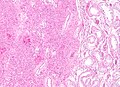 Leydig cell tumour
 -
 Leydig cell tumour
 -
 Leydig cell tumour
 -
 Gross pathology of a Leydig cell tumor of ovary


