Abietic acid: Difference between revisions
CSV import |
CSV import |
||
| Line 38: | Line 38: | ||
[[Category:Resin acids]] | [[Category:Resin acids]] | ||
[[Category:Diterpenes]] | [[Category:Diterpenes]] | ||
<gallery> | |||
File:Abietic_acid.svg|Abietic acid structure | |||
File:Abietic_Acid.png|Abietic acid | |||
File:AbietadieneBiosyn.svg|Abietadiene biosynthesis | |||
File:Geranylgeranyl_diphosphate_to_copalyl_diphosphate_mechanism_from_Peters_2010.svg|Geranylgeranyl diphosphate to copalyl diphosphate mechanism | |||
</gallery> | |||
Latest revision as of 05:00, 18 February 2025
Abietic acid[edit]


Abietic acid is an organic compound that is classified as a resin acid. It is one of the major components of rosin, the solid form of resin obtained from pines and some other plants, mostly conifers. Abietic acid is a colorless solid, although commercial samples are often yellowish.
Structure and properties[edit]
Abietic acid is a tricyclic diterpene with the molecular formula C20H30O2. It is a member of the abietane diterpene family, which is characterized by a three-ring structure. The acid is a carboxylic acid, with a carboxyl group (-COOH) attached to the tricyclic structure.
Biosynthesis[edit]

Abietic acid is biosynthesized from geranylgeranyl pyrophosphate (GGPP) through a series of enzymatic reactions. The biosynthesis involves the conversion of GGPP to copalyl diphosphate, which is then transformed into abietadiene. Abietadiene is subsequently oxidized to form abietic acid.

Uses[edit]
Abietic acid is primarily used in the production of rosin and its derivatives. Rosin is used in a variety of applications, including as a component in adhesives, varnishes, and inks. Abietic acid and its esters are also used in the manufacture of synthetic rubber and as a sizing agent in the paper industry.
Health and safety[edit]
Abietic acid can cause skin irritation and allergic reactions in some individuals. It is important to handle it with care and use appropriate protective equipment when working with it in industrial settings.
Related pages[edit]
Gallery[edit]
-
 Chemical structure of abietic acid
 -
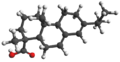 3D model of abietic acid
 -
 Biosynthesis of abietic acid
 -
 Mechanism of conversion from geranylgeranyl diphosphate to copalyl diphosphate
-
Abietic acid structure
-
Abietic acid
-
Abietadiene biosynthesis
-
Geranylgeranyl diphosphate to copalyl diphosphate mechanism
