Trihexyphenidyl: Difference between revisions
CSV import |
CSV import Tags: mobile edit mobile web edit |
||
| Line 40: | Line 40: | ||
[[Category:Anticholinergics]] | [[Category:Anticholinergics]] | ||
[[Category:Muscarinic antagonists]] | [[Category:Muscarinic antagonists]] | ||
<gallery> | |||
File:Trihexyphenidyl.svg|Trihexyphenidyl chemical structure | |||
File:Trihexyphenidyl_3D.png|3D model of Trihexyphenidyl | |||
File:Artane_Synthesis.jpg|Synthesis of Artane (Trihexyphenidyl) | |||
File:(R)-Trihexyphenidyl_Structural_Formula_V1.svg|(R)-Trihexyphenidyl structural formula | |||
File:(S)-Trihexyphenidyl_Structural_Formula_V1.svg|(S)-Trihexyphenidyl structural formula | |||
</gallery> | |||
Latest revision as of 04:59, 18 February 2025
Medication used to treat Parkinson's disease and drug-induced movement disorders


Trihexyphenidyl, also known by the brand name Artane, is a medication primarily used to treat Parkinson's disease and extrapyramidal symptoms caused by antipsychotic medications. It is classified as an anticholinergic agent.
Medical uses[edit]
Trihexyphenidyl is used to manage symptoms of Parkinson's disease, such as tremor, rigidity, and bradykinesia. It is also effective in treating drug-induced parkinsonism and other extrapyramidal side effects associated with the use of antipsychotic medications.
Mechanism of action[edit]
Trihexyphenidyl works by blocking acetylcholine receptors in the central nervous system. This action helps to restore the balance between acetylcholine and dopamine, which is often disrupted in Parkinson's disease and by certain medications.
Side effects[edit]
Common side effects of trihexyphenidyl include dry mouth, blurred vision, constipation, urinary retention, and confusion. In some cases, it may cause hallucinations or delirium, particularly in older adults.
Synthesis[edit]

The synthesis of trihexyphenidyl involves the reaction of alpha,alpha-diphenyl-4-piperidinemethanol with cyclohexyl bromide. This process results in the formation of the active compound.
Stereochemistry[edit]
Trihexyphenidyl has two enantiomers, (R)-trihexyphenidyl and (S)-trihexyphenidyl, which differ in their spatial arrangement.
-Trihexyphenidyl_Structural_Formula_V1.svg)
-Trihexyphenidyl_Structural_Formula_V1.svg)
History[edit]
Trihexyphenidyl was first introduced in the 1940s as a treatment for Parkinson's disease. It has since been used to manage drug-induced movement disorders, particularly those associated with antipsychotic medications.
Related pages[edit]
References[edit]
<references group="" responsive="1"></references>
-
 Trihexyphenidyl chemical structure
 -
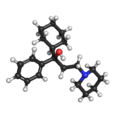 3D model of Trihexyphenidyl
 -
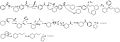 Synthesis of Artane (Trihexyphenidyl)
 -
 (R)-Trihexyphenidyl structural formula
 -
 (S)-Trihexyphenidyl structural formula
