Stokely Carmichael: Difference between revisions
CSV import |
CSV import Tags: mobile edit mobile web edit |
||
| Line 30: | Line 30: | ||
{{Civil rights movement}} | {{Civil rights movement}} | ||
{{medicine-stub}} | {{medicine-stub}} | ||
== Stokely Carmichael == | |||
<gallery> | |||
File:Kwame_Ture_at_a_1966_Mississippi_press_conference_(cropped).jpg|Kwame Ture at a 1966 Mississippi press conference | |||
File:Stokely_Carmichael_HS_Yearbook.jpg|Stokely Carmichael high school yearbook photo | |||
File:Kwame_Ture_at_a_1966_Mississippi_press_conference.jpg|Kwame Ture at a 1966 Mississippi press conference | |||
File:Miriam_Makeba,_Kwame_Ture,_Algiers,_1969.png|Miriam Makeba and Kwame Ture in Algiers, 1969 | |||
</gallery> | |||
Latest revision as of 04:58, 18 February 2025
Stokely Carmichael (June 29, 1941 – November 15, 1998) was a prominent Trinidadian-American activist in the Civil Rights Movement and the global Pan-African movement. Born in Port of Spain, Trinidad and Tobago, he moved to the United States in 1952 and attended Howard University, where he became involved in civil rights activism. Carmichael is best known for popularizing the term "Black Power" and as a leader in the Student Nonviolent Coordinating Committee (SNCC), where he eventually became the honorary prime minister of the Black Panther Party.
Early life and education[edit]
Stokely Carmichael was born in Port of Spain, Trinidad and Tobago, and immigrated to the United States at the age of 11. He attended the prestigious Bronx High School of Science in New York City before enrolling at Howard University. Howard was a center for student activism, and Carmichael quickly became involved in the civil rights movement.
Civil Rights Movement[edit]
During his tenure at Howard, Carmichael joined the SNCC and participated in the Freedom Rides, voter registration drives, and other forms of protest against racial segregation and injustice. His leadership and oratory skills helped him rise quickly within the ranks of the organization.
Black Power[edit]
In 1966, Carmichael coined the term "Black Power" during a march in Mississippi. The phrase became synonymous with a movement that sought to empower Black Americans through racial pride, economic self-sufficiency, and radical changes to the structure of American society. His advocacy for Black Power marked a significant shift in the tone of the civil rights movement, moving from a philosophy of nonviolence to one that allowed for self-defense against racial aggression.
Later life and impact[edit]
After stepping down from his role in the SNCC, Carmichael moved to Guinea in West Africa, where he changed his name to Kwame Ture, in honor of African leaders Kwame Nkrumah and Sékou Touré. He continued to advocate for Pan-Africanism and supported various international liberation movements from his base in Guinea until his death in 1998.
Carmichael's legacy is complex. He is revered as a pioneering advocate for Black empowerment and criticized for his turn towards separatism in later years. Nonetheless, his impact on the civil rights and Pan-African movements is undeniable.
See also[edit]

Stokely Carmichael[edit]
-
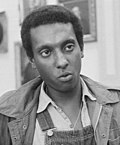 Kwame Ture at a 1966 Mississippi press conference
 -
 Stokely Carmichael high school yearbook photo
 -
 Kwame Ture at a 1966 Mississippi press conference
 -
 Miriam Makeba and Kwame Ture in Algiers, 1969
.jpg)


