Anterior longitudinal ligament: Difference between revisions
CSV import |
CSV import Tags: mobile edit mobile web edit |
||
| Line 31: | Line 31: | ||
[[Category:Vertebral column]] | [[Category:Vertebral column]] | ||
{{anatomy-stub}} | {{anatomy-stub}} | ||
<gallery> | |||
File:Gray301.png|Anterior longitudinal ligament | |||
File:Gray304.png|Anterior longitudinal ligament | |||
File:Anatomy_of_the_Neck_Sagittal_Color_MRI.png|Anterior longitudinal ligament | |||
File:Gray308.png|Anterior longitudinal ligament | |||
File:Gray312.png|Anterior longitudinal ligament | |||
</gallery> | |||
Latest revision as of 04:58, 18 February 2025
Anterior Longitudinal Ligament
The Anterior longitudinal ligament (ALL) is a crucial anatomical structure in the human body. It is one of the four main ligaments that provide stability to the vertebral column, the others being the posterior longitudinal ligament, the ligamentum flavum, and the interspinous ligament.
Anatomy[edit]
The ALL is a long, continuous band of fibrous tissue that runs along the anterior surface of the vertebral bodies from the base of the skull to the sacrum. It is broader at the top and bottom and narrower in the middle. The ALL is thicker and narrower in the thoracic region and thinner and wider in the lumbar region.
Function[edit]
The primary function of the ALL is to prevent excessive extension of the vertebral column. It also helps to maintain the alignment of the vertebral bodies and to resist anterior shear forces. The ALL is also involved in maintaining the lordotic curves of the cervical and lumbar spine.
Clinical Significance[edit]
Injuries to the ALL can occur due to trauma, such as a whiplash injury, or due to degenerative conditions, such as ankylosing spondylitis. These injuries can lead to instability of the vertebral column and can cause pain and disability. Diagnosis of ALL injuries is typically made through magnetic resonance imaging (MRI).
See Also[edit]
References[edit]
<references group="" responsive="1"></references>

-
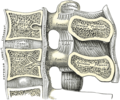 Anterior longitudinal ligament
 -
 Anterior longitudinal ligament
 -
 Anterior longitudinal ligament
 -
 Anterior longitudinal ligament
 -
 Anterior longitudinal ligament


