Evapotranspiration: Difference between revisions
CSV import Tags: mobile edit mobile web edit |
CSV import |
||
| Line 37: | Line 37: | ||
{{Hydrology-stub}} | {{Hydrology-stub}} | ||
<gallery> | |||
File:Surface_water_cycle.svg|Diagram illustrating the surface water cycle | |||
File:PET_wiki.png|Potential Evapotranspiration (PET) diagram | |||
File:Natural_&_impervious_cover_diagrams_EPA.jpg|Natural and impervious cover diagrams by EPA | |||
File:Lysimeter-design.png|Design of a lysimeter for measuring evapotranspiration | |||
File:Classification_of_RS-based_ET_models_based_on_sensible_heat_flux_estimation_approaches..png|Classification of remote sensing-based ET models | |||
</gallery> | |||
Latest revision as of 04:53, 18 February 2025
Evapotranspiration is a term used to describe the process by which water is transferred from the land to the atmosphere by evaporation from the soil and other surfaces and by transpiration from plants. It is a critical component of the hydrological cycle, which describes the movement of water within the Earth's atmosphere, surface, and subsurface environments. Understanding evapotranspiration is essential for various fields, including hydrology, agriculture, meteorology, and environmental science, as it plays a significant role in water resource management, climate modeling, and agricultural planning.
Overview[edit]
Evapotranspiration combines two processes: evaporation and transpiration. Evaporation is the process by which water changes from a liquid to a vapor state, occurring from surfaces such as soil, water bodies, and wet vegetation. Transpiration, on the other hand, is the process by which water within plants is transferred to the atmosphere as water vapor through small openings in leaves called stomata. Together, these processes contribute to the amount of moisture released into the atmosphere, influencing local and global climate patterns.
Factors Influencing Evapotranspiration[edit]
Several factors can affect the rate of evapotranspiration, including:
- Climate: Temperature, humidity, wind speed, and solar radiation are critical climatic factors that influence evapotranspiration rates.
- Soil Type: The characteristics of the soil, such as texture, structure, and moisture content, can impact the rate of evaporation from the soil surface.
- Vegetation Type: Different types of vegetation transpire at different rates due to variations in leaf area, root depth, and plant physiology.
- Water Availability: The availability of water in the soil for uptake by plants can limit transpiration rates.
Measurement and Estimation[edit]
Measuring evapotranspiration directly is challenging and often involves complex instruments and methodologies. However, several methods have been developed to estimate evapotranspiration rates, including:
- Lysimeters: Devices that measure the amount of water used by plants growing within them.
- Remote Sensing: Satellite or aerial imagery can be used to estimate evapotranspiration over large areas.
- Empirical Models: Mathematical models that estimate evapotranspiration based on climatic and environmental data.
Importance in Water Resource Management[edit]
Evapotranspiration plays a crucial role in water resource management. It is a significant component of the water balance equation, which is used to manage water resources in agriculture, urban planning, and environmental conservation. Understanding evapotranspiration rates helps in the efficient allocation of water for irrigation, the design of water conservation strategies, and the prediction of water availability in reservoirs and aquifers.
Challenges and Future Directions[edit]
One of the main challenges in the study of evapotranspiration is the accurate measurement and estimation of its rates across different spatial and temporal scales. Advances in technology, such as improved remote sensing techniques and more sophisticated models, are expected to enhance our understanding and prediction of evapotranspiration patterns. Additionally, climate change poses a challenge to predicting future evapotranspiration rates, as changing temperature and precipitation patterns may alter water cycles in unpredictable ways.
See Also[edit]

-
 Diagram illustrating the surface water cycle
 -
 Potential Evapotranspiration (PET) diagram
 -
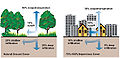 Natural and impervious cover diagrams by EPA
 -
 Design of a lysimeter for measuring evapotranspiration
 -
 Classification of remote sensing-based ET models


