Transpiration
Transpiration is the process by which moisture is carried through plants from roots to small pores on the underside of leaves, where it changes to vapor and is released to the atmosphere. Transpiration is essentially evaporation of water from plant leaves. It is a crucial part of the water cycle and plays a significant role in the regulation of temperature and water balance in plants.
Mechanism[edit]
Transpiration occurs mainly through small openings on the leaves called stomata. These openings are surrounded by guard cells that control their opening and closing. When stomata are open, water vapor escapes from the leaf into the atmosphere. This loss of water creates a negative pressure within the leaf, pulling more water up from the roots through the xylem.
Factors Affecting Transpiration[edit]
Several environmental factors influence the rate of transpiration:
Light[edit]
Light stimulates the opening of stomata, increasing the rate of transpiration. During the day, when light is abundant, transpiration rates are generally higher.
Temperature[edit]
Higher temperatures increase the rate of evaporation of water from leaf surfaces, thus increasing transpiration. Conversely, lower temperatures reduce the rate of transpiration.
Humidity[edit]
High humidity levels decrease the rate of transpiration because the air is already saturated with moisture, reducing the gradient for water vapor to diffuse out of the leaf.
Wind[edit]
Wind increases the rate of transpiration by removing the boundary layer of saturated air around the leaf, thus maintaining a high gradient for water vapor diffusion.
Importance of Transpiration[edit]
Transpiration serves several important functions in plants:
- Cooling: As water evaporates from the leaf surface, it cools the plant, similar to how sweating cools the human body.
- Nutrient Transport: Transpiration helps in the upward movement of water and dissolved minerals from the roots to the leaves.
- Water Balance: It maintains the water balance within the plant, preventing wilting.
Adaptations to Reduce Transpiration[edit]
Plants in arid environments have developed adaptations to minimize water loss. These include:
- Thick Cuticles: A waxy layer on leaves that reduces water loss.
- Reduced Leaf Area: Smaller leaves or spines reduce the surface area for transpiration.
- Stomatal Closure: Some plants can close their stomata during the hottest part of the day to conserve water.
Related Pages[edit]
References[edit]
-
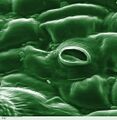 Tomato Leaf Stomate
 -
Afternoon Clouds over the Amazon Rainforest

Sponsored Health Resource

W8MD Weight Loss, Sleep & MedSpa
Looking for physician-supervised weight loss, semaglutide, tirzepatide, or GLP-1 receptor agonist options? W8MD helps eligible patients in New York City, Brooklyn, New Jersey, Connecticut, Pennsylvania, Delaware, and greater Philadelphia with medical weight loss, sleep medicine, and long-term maintenance support.
GLP-1 specials: Affordable GLP-1 injections NYC and Philadelphia starting from $29.99/week and up for semaglutide with insurance accepted for qualifying visits, and $45/week and up for tirzepatide with insurance accepted for qualifying visits. Self-pay options start from $59.99/week and up for semaglutide and $69.99/week and up for tirzepatide.
Medical weight loss NYC | Affordable GLP-1 injections NYC | Budget GLP-1 weight loss shots Philadelphia | New Jersey medical weight loss | NYC medical weight loss | Philadelphia medical weight loss | Sleep clinic NYC | W8MD's Philadelphia GLP-1 doctor | Weight loss prescriptions NYC
Book a W8MD appointment · View GLP-1 specials
Paid promotional message. Eligibility, pricing, insurance coverage, medication availability, and results vary. Medical evaluation required.

Medical Disclaimer: WikiMD is for informational purposes only and is not a substitute for professional medical advice. Content may be inaccurate or outdated and should not be used for diagnosis or treatment. Always consult your healthcare provider for medical decisions. Verify information with trusted sources such as CDC.gov and NIH.gov. By using this site, you agree that WikiMD is not liable for any outcomes related to its content. See full disclaimer.
Credits:Most images are courtesy of Wikimedia commons, and templates, categories Wikipedia, licensed under CC BY SA or similar.
Translate page: - East Asian
中文,
日本,
한국어,
South Asian
हिन्दी,
தமிழ்,
తెలుగు,
Urdu,
ಕನ್ನಡ,
Southeast Asian
Indonesian,
Vietnamese,
Thai,
မြန်မာဘာသာ,
বাংলা
European
español,
Deutsch,
français,
Greek,
português do Brasil,
polski,
română,
русский,
Nederlands,
norsk,
svenska,
suomi,
Italian
Middle Eastern & African
عربى,
Turkish,
Persian,
Hebrew,
Afrikaans,
isiZulu,
Kiswahili,
Other
Bulgarian,
Hungarian,
Czech,
Swedish,
മലയാളം,
मराठी,
ਪੰਜਾਬੀ,
ગુજરાતી,
Portuguese,
Ukrainian


