Urogenital triangle: Difference between revisions
CSV import |
CSV import Tags: mobile edit mobile web edit |
||
| Line 40: | Line 40: | ||
[[Category:Anatomy of the pelvis]] | [[Category:Anatomy of the pelvis]] | ||
[[Category:Human reproductive system]] | [[Category:Human reproductive system]] | ||
<gallery> | |||
File:1116_Muscle_of_the_Female_Perineum.png|Muscle of the Female Perineum | |||
File:1116_Muscle_of_the_Male_Perineum.png|Muscle of the Male Perineum | |||
File:Gray319.png|Urogenital triangle | |||
File:Gray542.png|Urogenital triangle | |||
File:Gray1077.png|Urogenital triangle | |||
</gallery> | |||
Latest revision as of 04:38, 18 February 2025
Anatomical region of the perineum
The urogenital triangle is a division of the perineum that includes the external genitalia and the openings of the urinary system. It is one of the two triangles of the perineum, the other being the anal triangle.
Anatomy[edit]
The urogenital triangle is located in the anterior part of the perineum. It is bounded by the pubic symphysis anteriorly, the ischiopubic rami laterally, and an imaginary line between the ischial tuberosities posteriorly. The triangle is oriented in a horizontal plane when the body is in the anatomical position.
Muscles[edit]
The urogenital triangle contains several important muscles, including the bulbospongiosus muscle, the ischiocavernosus muscle, and the superficial transverse perineal muscle. These muscles play a role in the function of the external genitalia and the support of the pelvic organs.
Fascia[edit]
The urogenital triangle is covered by the perineal fascia, which is divided into superficial and deep layers. The superficial fascia is further divided into a fatty layer and a membranous layer, known as Colles' fascia. The deep fascia, also known as the perineal membrane, provides support to the structures within the triangle.
Contents[edit]
In males, the urogenital triangle contains the root of the penis and the scrotum. In females, it contains the vulva, which includes the labia majora, labia minora, clitoris, and the openings of the urethra and vagina.
Function[edit]
The urogenital triangle plays a crucial role in the function of the urinary and reproductive systems. It supports the external genitalia and provides passage for the urethra and, in females, the vagina. The muscles of the urogenital triangle are involved in micturition, sexual function, and the support of pelvic organs.
Clinical significance[edit]
Injuries to the urogenital triangle can occur during childbirth, surgery, or trauma. Such injuries can affect the function of the urinary and reproductive systems and may require medical intervention.
Related pages[edit]
References[edit]
- Moore, K. L., Dalley, A. F., & Agur, A. M. R. (2013). Clinically Oriented Anatomy. Lippincott Williams & Wilkins.
- Standring, S. (2015). Gray's Anatomy: The Anatomical Basis of Clinical Practice. Elsevier Health Sciences.
-
 Muscle of the Female Perineum
 -
 Muscle of the Male Perineum
 -
Urogenital triangle
-
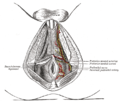 Urogenital triangle
 -
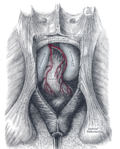 Urogenital triangle


