Ischial tuberosity
Ischial tuberosity is a large swelling posteriorly on the superior ramus of the Ischium. It is also known as the sitting bone. It is divided into two portions: a lower, rough, somewhat triangular part, and an upper, smooth, quadrilateral part. The ischial tuberosity bears the weight of the body when sitting.
Anatomy[edit]
The Ischium is one of the three parts of the hip bone, or os coxae, and the ischial tuberosity is a part of this bone. It is located on the posterior side of the body, and is the part of the body that makes contact with the ground when we sit down. The ischial tuberosity is connected to various muscles and ligaments, including the semimembranosus, semitendinosus, biceps femoris, and adductor magnus muscles.
Function[edit]
The ischial tuberosity serves as an attachment site for several muscles, including the hamstring muscles and the sacrotuberous ligament. It also serves as a support for the body when sitting. The ischial tuberosity is particularly important in weight distribution during sitting, as it bears the weight of the body.
Clinical significance[edit]
Injuries or conditions affecting the ischial tuberosity can cause pain and discomfort, particularly when sitting. These conditions include ischial bursitis, also known as weaver's bottom, and hamstring injuries. Ischial bursitis is inflammation of the bursa that lies over the ischial tuberosity, while hamstring injuries often involve a tear or strain of the muscles attached to the ischial tuberosity.
See also[edit]

Ischial_tuberosity[edit]
-
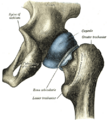 Ischial tuberosity
 -
 Tuberosity of the ischium
 -
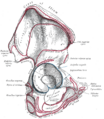 Ischial tuberosity
 -
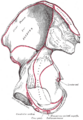 Ischial tuberosity
 -
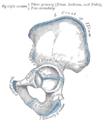 Ischial tuberosity
 -
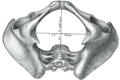 Ischial tuberosity
 -
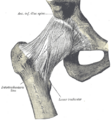 Ischial tuberosity
 -
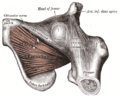 Ischial tuberosity
 -
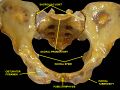 Ischial tuberosity


Medical Disclaimer: WikiMD is for informational purposes only and is not a substitute for professional medical advice. Content may be inaccurate or outdated and should not be used for diagnosis or treatment. Always consult your healthcare provider for medical decisions. Verify information with trusted sources such as CDC.gov and NIH.gov. By using this site, you agree that WikiMD is not liable for any outcomes related to its content. See full disclaimer.
Credits:Most images are courtesy of Wikimedia commons, and templates, categories Wikipedia, licensed under CC BY SA or similar.
Translate page: - East Asian
中文,
日本,
한국어,
South Asian
हिन्दी,
தமிழ்,
తెలుగు,
Urdu,
ಕನ್ನಡ,
Southeast Asian
Indonesian,
Vietnamese,
Thai,
မြန်မာဘာသာ,
বাংলা
European
español,
Deutsch,
français,
Greek,
português do Brasil,
polski,
română,
русский,
Nederlands,
norsk,
svenska,
suomi,
Italian
Middle Eastern & African
عربى,
Turkish,
Persian,
Hebrew,
Afrikaans,
isiZulu,
Kiswahili,
Other
Bulgarian,
Hungarian,
Czech,
Swedish,
മലയാളം,
मराठी,
ਪੰਜਾਬੀ,
ગુજરાતી,
Portuguese,
Ukrainian

