Urine cytology: Difference between revisions
CSV import |
CSV import Tags: mobile edit mobile web edit |
||
| Line 37: | Line 37: | ||
[[Category:Medical tests]] | [[Category:Medical tests]] | ||
[[Category:Cytopathology]] | [[Category:Cytopathology]] | ||
<gallery> | |||
File:The_Paris_System_for_reporting_urinary_cytology_2.0.png|The Paris System for reporting urinary cytology 2.0 | |||
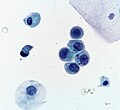
File:Cytology_of_normal_urothelial_cells,_Pap_stain.jpg|Cytology of normal urothelial cells, Pap stain | |||
File:HIgh-Grade_Urothelial_Carcinoma_(28263697589).jpg|High-Grade Urothelial Carcinoma | |||
File:Decoy_cell_cytology.png|Decoy cell cytology | |||
File:Urine_cytology_with_red_blood_cells.jpg|Urine cytology with red blood cells | |||
</gallery> | |||
Latest revision as of 04:37, 18 February 2025
Urine Cytology[edit]


.jpg)


Urine cytology is a diagnostic test used to detect cancer and other diseases of the urinary tract. It involves the examination of cells in a urine sample under a microscope. This test is particularly useful for identifying urothelial carcinoma, a type of bladder cancer.
Procedure[edit]
The urine cytology test is typically performed on a freshly voided urine sample. The sample is processed to concentrate the cells, which are then stained using the Papanicolaou stain (Pap stain) to enhance cellular detail. A cytopathologist examines the stained cells under a microscope to identify any abnormalities.
Indications[edit]
Urine cytology is primarily indicated for patients with symptoms suggestive of bladder cancer, such as hematuria (blood in the urine), or for those with a history of bladder cancer to monitor for recurrence. It may also be used to evaluate other urinary tract conditions.
The Paris System[edit]
The Paris System for Reporting Urinary Cytology is a standardized reporting system that categorizes urine cytology findings into specific diagnostic categories. This system aims to improve the accuracy and consistency of urine cytology reports, particularly in the detection of high-grade urothelial carcinoma.
Limitations[edit]
While urine cytology is effective in detecting high-grade urothelial carcinoma, it has limitations in identifying low-grade tumors. False negatives can occur, and the test may not detect all types of bladder cancer. Therefore, it is often used in conjunction with other diagnostic methods, such as cystoscopy.
Related Pages[edit]
References[edit]
<references group="" responsive="1"></references>
-
 The Paris System for reporting urinary cytology 2.0
 -
 Cytology of normal urothelial cells, Pap stain
 -
 High-Grade Urothelial Carcinoma
 -
 Decoy cell cytology
 -
 Urine cytology with red blood cells
