Adenosine triphosphate: Difference between revisions
CSV import |
CSV import |
||
| Line 43: | Line 43: | ||
[[Category:Cellular respiration]] | [[Category:Cellular respiration]] | ||
[[Category:Energy (biology)]] | [[Category:Energy (biology)]] | ||
<gallery> | |||
File:Adenosintriphosphat_protoniert.svg|Adenosine triphosphate protonated structure | |||
File:AdenosineTriphosphate.qutemol.svg|3D model of adenosine triphosphate | |||
File:ATP-ADP.svg|Conversion of ATP to ADP | |||
File:MgATP2-small.gif|Magnesium-ATP complex | |||
File:Rossmann-fold-1g5q.png|Rossmann fold structure | |||
</gallery> | |||
Revision as of 04:34, 18 February 2025
Adenosine triphosphate


Adenosine triphosphate (ATP) is a complex organic chemical that provides energy to drive many processes in living cells, such as muscle contraction, nerve impulse propagation, and chemical synthesis. Found in all forms of life, ATP is often referred to as the "molecular unit of currency" of intracellular energy transfer.
Structure
ATP consists of an adenosine molecule bonded to three phosphate groups. The adenosine molecule is composed of an adenine ring and a ribose sugar. The three phosphate groups are labeled alpha, beta, and gamma, starting with the group closest to the ribose.
Function
ATP is used by cells as a coenzyme. It transports chemical energy within cells for metabolism. Most cellular functions require energy in the form of ATP, including the synthesis of macromolecules, such as DNA and RNA, and the active transport of molecules across cell membranes.
Synthesis
ATP is synthesized from adenosine diphosphate (ADP) and inorganic phosphate (Pi) by the enzyme ATP synthase during oxidative phosphorylation in mitochondria and photophosphorylation in chloroplasts.
Hydrolysis
The hydrolysis of ATP into ADP and Pi releases energy that is used by the cell to perform work. This reaction is catalyzed by enzymes known as ATPases.
Role in Metabolism
ATP is central to metabolism. It is involved in glycolysis, the citric acid cycle, and the electron transport chain. ATP is also crucial in anabolism, where it provides the energy for the synthesis of complex molecules.
ATP and Muscle Contraction
ATP is essential for muscle contraction. It binds to myosin, allowing it to detach from actin and re-cock, ready for another contraction cycle. The energy released from ATP hydrolysis is used to power the movement of myosin along actin filaments.
ATP in Signal Transduction
ATP is involved in signal transduction pathways. It acts as a substrate for kinases, which phosphorylate proteins, altering their activity and function. ATP is also a precursor for the synthesis of cyclic AMP (cAMP), a secondary messenger in many signaling pathways.
Gallery
-
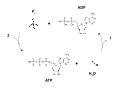 Conversion of ATP to ADP.
 -
 Magnesium-ATP complex.
 -
 Rossmann fold, a common motif in ATP-binding proteins.


Related pages
-
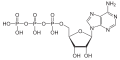 Adenosine triphosphate protonated structure
 -
 3D model of adenosine triphosphate
 -
Conversion of ATP to ADP
-
Magnesium-ATP complex
-
Rossmann fold structure
