Pecel: Difference between revisions
CSV import Tags: mobile edit mobile web edit |
CSV import |
||
| Line 20: | Line 20: | ||
{{Indonesian-cuisine-stub}} | {{Indonesian-cuisine-stub}} | ||
{{food-stub}} | {{food-stub}} | ||
<gallery> | |||
File:Pecel_Hariadhi.JPG|Pecel | |||
File:Penjual_pecel_di_Borobudur.JPG|Penjual pecel di Borobudur | |||
File:Pecel_Solo.JPG|Pecel Solo | |||
File:Nasi_Pecel_Khas_Madiun.jpg|Nasi Pecel Khas Madiun | |||
File:Nasi_Pecel_Daun_Jati.jpg|Nasi Pecel Daun Jati | |||
File:MIE_PECEL.jpg|Mie Pecel | |||
</gallery> | |||
Latest revision as of 04:24, 18 February 2025
Pecel is a traditional Indonesian dish that is commonly found in Java. It is a type of salad that is served with a spicy peanut sauce. The main ingredients of Pecel include a variety of boiled vegetables, such as spinach, bean sprouts, cabbage, and long beans, which are then mixed with the peanut sauce.
Ingredients[edit]
The peanut sauce used in Pecel is made from ground peanuts, palm sugar, tamarind, chilies, garlic, and kaffir lime leaves. The sauce is typically made by grinding the peanuts and the other ingredients together until they form a smooth paste.
Variations[edit]
There are several variations of Pecel, depending on the region in Indonesia. For example, in Central Java, Pecel is often served with tempeh or tofu, while in East Java, it is commonly served with rice or lontong, a type of rice cake.
Cultural Significance[edit]
Pecel is often eaten as a main dish, but it can also be served as a side dish or a snack. It is a popular choice for breakfast in many parts of Indonesia, particularly in Java. The dish is also commonly served during traditional ceremonies and celebrations.
See Also[edit]
This article is a Indonesian cuisine stub. You can help WikiMD by expanding it!

-
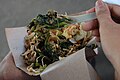 Pecel
Pecel -
 Penjual pecel di Borobudur
 -
 Pecel Solo
 -
Nasi Pecel Khas Madiun
-
Nasi Pecel Daun Jati
-
Mie Pecel


