5-Sulfosalicylic acid: Difference between revisions
CSV import |
CSV import |
||
| Line 38: | Line 38: | ||
[[Category:Sulfonic acids]] | [[Category:Sulfonic acids]] | ||
[[Category:Laboratory techniques]] | [[Category:Laboratory techniques]] | ||
<gallery> | |||
File:Sulfosalicylic_acid.svg|Sulfosalicylic acid structure | |||
File:5-Sulfosalicylic_acid_ball-and-stick_animation.gif|5-Sulfosalicylic acid ball-and-stick animation | |||
File:Kyselina_sulfosalicylová.jpg|5-Sulfosalicylic acid | |||
</gallery> | |||
Latest revision as of 04:04, 18 February 2025
A chemical compound used in medical and laboratory settings
| Chemical compounds | ||||||||
|---|---|---|---|---|---|---|---|---|
This chemical compound related article is a stub.
|
5-Sulfosalicylic acid is an organic compound with the formula C7H6O6S. It is a sulfonic acid derivative of salicylic acid. This compound is commonly used in medical laboratories for the detection of protein in urine samples.
Structure and Properties[edit]
5-Sulfosalicylic acid is a white crystalline solid that is soluble in water. It is characterized by the presence of both a carboxylic acid group and a sulfonic acid group, which contribute to its acidic properties. The molecular structure can be represented by the following images:


Applications[edit]
Medical Use[edit]
In clinical settings, 5-sulfosalicylic acid is primarily used for the qualitative analysis of proteinuria. When added to a urine sample, it causes proteins to precipitate, allowing for the detection of albumin and other proteins. This test is particularly useful in diagnosing and monitoring kidney disease.
Laboratory Use[edit]
Beyond its medical applications, 5-sulfosalicylic acid is also used in various laboratory procedures. It serves as a reagent in biochemical assays and can be used to precipitate proteins from solutions, aiding in their purification and analysis.
Safety and Handling[edit]
5-Sulfosalicylic acid should be handled with care, as it is a strong acid and can cause irritation to the skin, eyes, and respiratory tract. Appropriate personal protective equipment such as gloves and goggles should be worn when handling this compound.
Related Compounds[edit]
Gallery[edit]
-
 Crystalline form of 5-Sulfosalicylic acid

Related pages[edit]
-
 Sulfosalicylic acid structure
 -
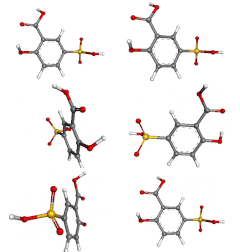 5-Sulfosalicylic acid ball-and-stick animation
 -
5-Sulfosalicylic acid
