Acetic anhydride: Difference between revisions
CSV import |
CSV import |
||
| Line 49: | Line 49: | ||
[[Category:Acid anhydrides]] | [[Category:Acid anhydrides]] | ||
[[Category:Reagents for organic chemistry]] | [[Category:Reagents for organic chemistry]] | ||
<gallery> | |||
File:Acetic_anhydride2DACS.svg|Structural formula of acetic anhydride | |||
File:Acetic-anhydride-from-xtal-2003-3D-balls.png|3D ball model of acetic anhydride | |||
File:Acetic_anhydride.jpg|Acetic anhydride | |||
</gallery> | |||
Latest revision as of 03:48, 18 February 2025
Acetic anhydride[edit]


Acetic anhydride, also known as ethanoic anhydride, is a chemical compound with the formula (CH_CO)_O. It is the simplest isolable acid anhydride and is widely used as a reagent in organic synthesis.
Structure and properties[edit]
Acetic anhydride is a colorless liquid with a pungent odor. It is the simplest anhydride of acetic acid and is a member of the class of acyclic carboxylic anhydrides. The molecule consists of two acetyl groups (CH_CO) linked by an oxygen atom. The compound is highly reactive and is a powerful acetylating agent.
Physical properties[edit]
Acetic anhydride has a boiling point of 139.8 °C and a melting point of -73.1 °C. It is soluble in ether, chloroform, and benzene, but reacts with water to form acetic acid.
Chemical properties[edit]
Acetic anhydride is a versatile reagent in organic chemistry. It reacts with alcohols and amines to form esters and amides, respectively. It is also used in the synthesis of acetylated compounds, such as acetylsalicylic acid (aspirin).
Production[edit]
Acetic anhydride is produced by the carbonylation of methyl acetate in the presence of a rhodium or iridium catalyst. It can also be prepared by the dehydration of acetic acid using phosphorus pentoxide.
Applications[edit]
Acetic anhydride is used in the manufacture of cellulose acetate, a component of photographic film and other coatings. It is also used in the production of aspirin, heroin, and other pharmaceuticals. Additionally, it serves as a reagent in the synthesis of dyes, flavors, and fragrances.
Safety and handling[edit]
Acetic anhydride is corrosive and can cause severe burns upon contact with skin or eyes. It should be handled with appropriate protective equipment, including gloves and goggles. Inhalation of its vapors can cause respiratory irritation.
Related pages[edit]
Gallery[edit]
-
 Structural formula of acetic anhydride
 -
 3D ball model of acetic anhydride
 -
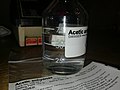 Acetic anhydride in a laboratory setting
-
Structural formula of acetic anhydride
-
3D ball model of acetic anhydride
-
Acetic anhydride
