Pistacia integerrima: Difference between revisions
CSV import |
CSV import |
||
| Line 27: | Line 27: | ||
{{plants-stub}} | {{plants-stub}} | ||
{{food-stub}} | {{food-stub}} | ||
<gallery> | |||
File:Pistacia_khinjuk_Bra22.png|Pistacia_integerrima | |||
File:Galls_of_pistacia_integerrima.jpeg|Galls of Pistacia integerrima | |||
</gallery> | |||
Latest revision as of 01:32, 18 February 2025
Pistacia integerrima, commonly known as the Kakkar or Kakarsingi, is a species of flowering plant in the Anacardiaceae family. It is native to Asia, particularly the Indian subcontinent and Afghanistan.
Description[edit]
The Pistacia integerrima is a deciduous tree that can grow up to 10 meters in height. It has pinnate leaves, with 7 to 9 leaflets that are lanceolate to narrowly elliptic. The flowers are small and greenish, while the fruit is a small drupe turning red to black when ripe.
Distribution and Habitat[edit]
Pistacia integerrima is found in the temperate Himalayas from Kashmir to Nepal, at altitudes of 600-2500 meters. It prefers open, sunny areas and is often found on dry, rocky slopes.
Uses[edit]
The plant has various uses in traditional medicine. The galls produced by the plant are used in Ayurveda and Unani medicine. They are known to have expectorant, anti-inflammatory, and antispasmodic properties. The fruit is also used in the treatment of respiratory disorders such as asthma and bronchitis.
Cultivation[edit]
Pistacia integerrima is propagated by seeds. The plant prefers well-drained soil and can tolerate drought conditions. It is a hardy plant and can withstand cold temperatures.
Conservation Status[edit]
The species is not currently listed as threatened or endangered. However, overharvesting for medicinal use and habitat loss due to deforestation are potential threats to its survival.
See Also[edit]
This plant related article is a stub. You can help WikiMD by expanding it.

-
 Pistacia_integerrima
 -
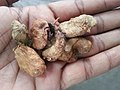 Galls of Pistacia integerrima


