Chakhchoukha: Difference between revisions
CSV import |
CSV import |
||
| Line 20: | Line 20: | ||
{{Algerian cuisine}} | {{Algerian cuisine}} | ||
{{food-stub}} | {{food-stub}} | ||
<gallery> | |||
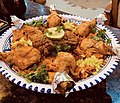
File:Algerian_Chakhchoukha.jpg|Chakhchoukha | |||
File:Chakhchoukhah.jpg|Chakhchoukha | |||
</gallery> | |||
Latest revision as of 01:32, 18 February 2025
Chakhchoukha is a traditional Algerian dish, originating from the Saharan region of Algeria. It is particularly popular in the regions of Biskra and Tebessa, where it is considered a staple food. The dish is also commonly consumed in other parts of the country and has gained popularity in various other North African countries.
Ingredients and Preparation[edit]
Chakhchoukha primarily consists of two components: r'fiss (torn pieces of flatbread) and marka (a stew). The r'fiss is made from a dough of semolina, water, salt, and sometimes olive oil. This dough is rolled out, cooked on a flat pan, and then torn into small pieces. The marka typically includes lamb or chicken, chickpeas, and a variety of spices such as coriander, cumin, paprika, and cayenne pepper. The r'fiss and marka are usually served together, with the marka poured over the r'fiss.
Cultural Significance[edit]
Chakhchoukha is often prepared for special occasions and celebrations, such as weddings and religious holidays. It is also a common dish during the month of Ramadan, when it is often served for the breaking of the fast. The dish is considered a symbol of Algerian hospitality and is often served to guests as a sign of welcome.
Variations[edit]
There are several regional variations of Chakhchoukha. In the region of Biskra, for example, the marka is often made with a special type of red chili pepper known as Biskra pepper. In Tebessa, the marka is typically thicker and may include additional ingredients such as tomatoes and garlic.
See Also[edit]
| Algerian cuisine | ||||||||||
|---|---|---|---|---|---|---|---|---|---|---|
* Category
|

-
 Chakhchoukha
 -
 Chakhchoukha


