GTP-binding protein regulators: Difference between revisions
CSV import |
CSV import |
||
| Line 28: | Line 28: | ||
[[Category:Molecular biology]] | [[Category:Molecular biology]] | ||
{{protein-stub}} | {{protein-stub}} | ||
<gallery> | |||
File:GDP_chemical_structure.png|GDP chemical structure | |||
File:GTP_chemical_structure.png|GTP chemical structure | |||
</gallery> | |||
Latest revision as of 01:18, 18 February 2025
GTP-binding protein regulators are a class of proteins that regulate the activity of GTP-binding proteins. These regulators play a crucial role in various cellular processes, including signal transduction, protein synthesis, and intracellular transport.
Function[edit]
GTP-binding protein regulators function by controlling the activity of GTP-binding proteins. These proteins, also known as G-proteins, act as molecular switches in cells. They are active when bound to GTP and inactive when bound to GDP. The regulators can either activate or inhibit the G-proteins, depending on the specific type of regulator and the cellular context.
Types[edit]
There are several types of GTP-binding protein regulators, including:
- Guanine nucleotide exchange factors (GEFs): These regulators promote the exchange of GDP for GTP, thereby activating the G-protein.
- GTPase-activating proteins (GAPs): These regulators accelerate the intrinsic GTPase activity of the G-protein, leading to its inactivation.
- Guanine nucleotide dissociation inhibitors (GDIs): These regulators prevent the dissociation of GDP from the G-protein, keeping it in an inactive state.
Role in disease[edit]
Abnormalities in GTP-binding protein regulators can lead to various diseases. For example, mutations in GEFs, GAPs, or GDIs can result in abnormal activation or inactivation of G-proteins, leading to diseases such as cancer, neurological disorders, and metabolic diseases.
See also[edit]

-
 GDP chemical structure
 -
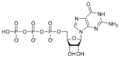 GTP chemical structure


