Stevia rebaudiana: Difference between revisions
CSV import Tags: mobile edit mobile web edit |
CSV import |
||
| Line 28: | Line 28: | ||
{{plant-stub}} | {{plant-stub}} | ||
{{medicine-stub}} | {{medicine-stub}} | ||
<gallery> | |||
File:Stevia_rebaudiana_flowers.jpg|Stevia rebaudiana flowers | |||
File:Stevia-rebaudiana-total.JPG|Stevia rebaudiana plant | |||
</gallery> | |||
Latest revision as of 01:00, 18 February 2025
Stevia rebaudiana is a plant species in the genus Stevia of the family Asteraceae, native to Brazil and Paraguay. The plant is widely grown for its sweet leaves, which are used as a sweetener and sugar substitute.
Description[edit]
Stevia rebaudiana is a perennial herb that grows up to 1 meter tall. The leaves are oppositely arranged, lanceolate, 2-3 cm long, and have a sweet taste. The flowers are white, tubular, and arranged in loose clusters. The fruit is a small achene.
Cultivation[edit]
Stevia rebaudiana is cultivated in many countries, especially in East Asia, for its sweet leaves. The plant prefers a warm, humid climate, well-drained soil, and full sun. It is propagated by seeds, cuttings, or division.
Uses[edit]
The leaves of Stevia rebaudiana are used as a sweetener and sugar substitute. They contain steviol glycosides, especially stevioside and rebaudioside, which are 200-300 times sweeter than sugar but have no calories. The leaves are used fresh or dried, and are also processed into a white powder or a liquid extract.
Health effects[edit]
The steviol glycosides in Stevia rebaudiana have been studied for their potential health benefits. They have been found to have anti-diabetic, anti-hypertensive, anti-inflammatory, anti-tumor, anti-diarrheal, diuretic, and immunomodulatory effects. However, more research is needed to confirm these effects and to understand their mechanisms of action.
Regulatory status[edit]
The use of Stevia rebaudiana as a sweetener is regulated in many countries. In the United States, the Food and Drug Administration (FDA) has approved the use of rebaudioside A, one of the steviol glycosides, as a food additive, but not stevioside or the whole leaf. In the European Union, the European Food Safety Authority (EFSA) has approved the use of steviol glycosides as a food additive, but not the whole leaf.
See also[edit]


-
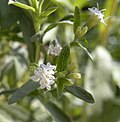 Stevia rebaudiana flowers
 -
 Stevia rebaudiana plant


