Palestinian sweet lime: Difference between revisions
CSV import Tags: mobile edit mobile web edit |
CSV import |
||
| Line 22: | Line 22: | ||
[[Category:Middle Eastern cuisine]] | [[Category:Middle Eastern cuisine]] | ||
{{food-stub}} | {{food-stub}} | ||
== Palestinian_sweet_lime == | |||
<gallery> | |||
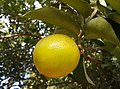
File:Citrus_limettioides_-_Palestine_sweet_lime.jpg|Palestinian sweet lime on tree | |||
File:Lima-da-pérsia,_Rio_de_Janeiro.jpg|Lima da pérsia, Rio de Janeiro | |||
</gallery> | |||
Latest revision as of 00:48, 18 February 2025
Palestinian sweet lime (Citrus limettioides) is a type of lime that is native to the Palestinian region. It is known for its sweet flavor, which distinguishes it from other lime varieties.
Description[edit]
The Palestinian sweet lime is a medium-sized citrus tree that typically grows to a height of 5-6 meters. The tree produces round, yellow fruits that are slightly larger than a typical lime. The fruit's flesh is sweet and juicy, with a flavor that is less acidic than that of a typical lime.
Cultivation[edit]
Palestinian sweet limes are grown in several countries in the Middle East, including Palestine, Israel, and Jordan. They are also cultivated in parts of North Africa, including Egypt and Morocco. The trees prefer a warm, sunny climate and well-drained soil. They are typically propagated through grafting.
Uses[edit]
The fruit of the Palestinian sweet lime is often eaten fresh, but it can also be used in cooking and baking. It is a common ingredient in Middle Eastern cuisine, where it is used in dishes such as tabbouleh and hummus. The juice of the fruit is also used in beverages, such as limeade and cocktails.
Health Benefits[edit]
Palestinian sweet limes are rich in vitamin C and other antioxidants, which can help to boost the immune system and protect against disease. They also contain dietary fiber, which can aid in digestion.
See Also[edit]

Palestinian_sweet_lime[edit]
-
 Palestinian sweet lime on tree
 -
 Lima da pérsia, Rio de Janeiro


