Kabkab: Difference between revisions
CSV import Tags: mobile edit mobile web edit |
CSV import |
||
| Line 22: | Line 22: | ||
{{Philippine-cuisine-stub}} | {{Philippine-cuisine-stub}} | ||
{{food-stub}} | {{food-stub}} | ||
<gallery> | |||
File:Kabkab_(Cassava_cracker),_Philippines_04.jpg|Kabkab | |||
File:Kabkab_(Philippines)_03.jpg|Kabkab | |||
</gallery> | |||
Latest revision as of 00:46, 18 February 2025
Kabkab is a type of cracker or flatbread that originates from the Philippines. It is a staple food in many regions of the country, particularly in the Visayas and Mindanao regions. Kabkab is typically made from rice or corn, and is often served with dips or used as a base for canapés.
History[edit]
The exact origins of Kabkab are unknown, but it is believed to have been a staple food in the Philippines for centuries. It is often associated with the Visayan people, who are known for their rice-based cuisine. The name "Kabkab" is derived from the Visayan language, and is thought to refer to the sound made when the cracker is bitten into.
Preparation[edit]
Kabkab is made by mixing rice or corn flour with water to form a dough. This dough is then spread thinly on a flat surface and allowed to dry in the sun. Once dry, the dough is cut into squares and baked until crisp. The resulting crackers are light and crunchy, with a mild flavor that pairs well with a variety of dips and toppings.
Uses[edit]
Kabkab is a versatile food that can be used in a variety of ways. It can be eaten on its own as a snack, or used as a base for canapés. It is also commonly served with dips, such as mango salsa, guacamole, or bagoong (a Filipino fermented fish paste). In addition, Kabkab can be used as a substitute for rice or bread in many dishes.
Cultural Significance[edit]
In the Philippines, Kabkab is more than just a food item. It is a symbol of the country's rich cultural heritage and culinary traditions. The process of making Kabkab is often a communal activity, with families and neighbors coming together to prepare the dough, dry it in the sun, and bake the crackers. This sense of community is a key part of the Kabkab tradition, and is one of the reasons why this simple cracker holds such a special place in Filipino culture.


-
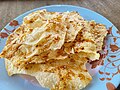 Kabkab
 -
 Kabkab
,_Philippines_04.jpg)
_03.jpg)
