Para-Fluorophenylpiperazine: Difference between revisions
CSV import |
CSV import Tags: mobile edit mobile web edit |
||
| Line 29: | Line 29: | ||
{{Chem-stub}} | {{Chem-stub}} | ||
{{Pharma-stub}} | {{Pharma-stub}} | ||
<gallery> | |||
File:Para-Fluorophenylpiperazine PFPP.svg|Para-Fluorophenylpiperazine PFPP structure | |||
File:PFPP3d.png|3D model of PFPP | |||
</gallery> | |||
Revision as of 02:12, 17 February 2025
Para-Fluorophenylpiperazine (pFPP) is a piperazine derivative that is used in scientific research. It is a fluorinated compound, which means it contains a fluorine atom. pFPP is known for its serotonin receptor agonist activity, particularly at the 5-HT1A and 5-HT2A receptors.
Chemistry
Para-Fluorophenylpiperazine is a member of the piperazine class of compounds. Piperazines are a broad class of chemical compounds, many with important pharmacological properties, which contain a core piperazine functional group. This functional group consists of a six-membered ring containing two nitrogen atoms at opposite positions in the ring.
The term "para-fluorophenyl" refers to the specific substitution pattern of the phenyl ring. In this case, the fluorine atom is attached to the phenyl ring at the para position, which is the position directly across from the attachment point of the phenyl ring to the piperazine ring.
Pharmacology
pFPP acts as a serotonin receptor agonist. Serotonin receptors are a group of G protein-coupled receptors and ligand-gated ion channels found in the central nervous system and peripheral nervous system. They mediate both excitatory and inhibitory neurotransmission. The serotonin receptors are activated by the neurotransmitter serotonin, which acts as their natural ligand.
pFPP has been found to have a high affinity for the 5-HT1A and 5-HT2A receptors. The 5-HT1A receptor is a subtype of serotonin receptor that is thought to play a significant role in anxiety, depression, and schizophrenia. The 5-HT2A receptor is primarily found in the cerebral cortex and is thought to play a key role in the cognitive functions of the brain, particularly in memory and learning.
Research Use
Due to its activity at the serotonin receptors, pFPP is used in scientific research to study the role of these receptors in various neurological and psychiatric disorders. It can be used as a tool to better understand the function of the serotonin system in the brain and how it may be implicated in conditions such as depression, anxiety, and schizophrenia.
See Also


-
Para-Fluorophenylpiperazine PFPP structure
-
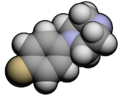 3D model of PFPP


