Abfraction: Difference between revisions
CSV import |
CSV import |
||
| Line 1: | Line 1: | ||
{{Short description|Loss of tooth structure from | {{Short description|Loss of tooth structure from mechanical forces}} | ||
{{ | {{Tooth anatomy}} | ||
'''Abfraction''' is a theoretical concept in dentistry that describes the loss of tooth structure, particularly at the cervical areas of teeth, due to | '''Abfraction''' is a theoretical concept in dentistry that describes the loss of tooth structure, particularly at the cervical areas of teeth, due to mechanical forces. This phenomenon is believed to occur as a result of [[occlusal]] forces that cause flexure and stress concentration at the cervical regions of the teeth, leading to [[enamel]] and [[dentin]] loss. | ||
==Mechanism== | ==Mechanism== | ||
Abfraction is | Abfraction is thought to occur when occlusal forces, such as those from [[chewing]] or [[bruxism]], create stress concentrations at the cervical areas of the teeth. These forces cause the tooth to flex, leading to microfractures in the enamel and dentin. Over time, these microfractures can result in the loss of tooth structure, forming characteristic wedge-shaped defects. | ||
==Clinical Presentation== | ==Clinical Presentation== | ||
Abfraction lesions | Abfraction lesions typically appear as wedge-shaped notches at the cervical areas of the teeth, near the [[gingival margin]]. These lesions are often found on the [[buccal]] or [[facial]] surfaces of the teeth and can vary in depth and width. They may be accompanied by [[tooth sensitivity]] due to the exposure of dentin. | ||
==Differential Diagnosis== | |||
Abfraction should be differentiated from other types of non-carious cervical lesions, such as: | |||
* [[Abrasion (dental)|Abrasion]]: Loss of tooth structure due to mechanical wear, often from aggressive tooth brushing. | |||
* [[Erosion (dental)|Erosion]]: Loss of tooth structure due to chemical processes, such as exposure to acidic substances. | |||
== | ==Management== | ||
The management of abfraction lesions involves addressing the underlying occlusal forces and restoring the lost tooth structure. Treatment options may include: | |||
* Occlusal adjustment to reduce excessive forces on the affected teeth. | |||
* Use of [[night guard]]s to prevent damage from bruxism. | |||
* Restorative procedures, such as [[composite resin]] fillings, to restore the lost tooth structure and protect the dentin. | |||
* Occlusal adjustment to reduce excessive forces | |||
* Use of [[night guard]]s to prevent bruxism | |||
* Restorative procedures, such as composite resin fillings, to restore the tooth | |||
==Related pages== | ==Related pages== | ||
* [[Tooth wear]] | * [[Tooth wear]] | ||
* [[Bruxism]] | * [[Bruxism]] | ||
* [[ | * [[Occlusion (dentistry)]] | ||
* [[ | * [[Tooth sensitivity]] | ||
==Gallery== | ==Gallery== | ||
<gallery> | <gallery> | ||
File:Abfraction.jpg|Abfraction lesion on a tooth | File:Abfraction.jpg|Abfraction lesion on a tooth | ||
File:Dental_abrasion_klinovidny_de207.jpg|Example of | File:Dental_abrasion_klinovidny_de207.jpg|Example of a cervical lesion | ||
File:Abfraction_lesion_final.jpg|Close-up of an abfraction lesion | File:Abfraction_lesion_final.jpg|Close-up of an abfraction lesion | ||
</gallery> | </gallery> | ||
Revision as of 21:11, 11 February 2025
Loss of tooth structure from mechanical forces
| Dental anatomy | ||||||||||||||||||||||||
|---|---|---|---|---|---|---|---|---|---|---|---|---|---|---|---|---|---|---|---|---|---|---|---|---|
|
Abfraction is a theoretical concept in dentistry that describes the loss of tooth structure, particularly at the cervical areas of teeth, due to mechanical forces. This phenomenon is believed to occur as a result of occlusal forces that cause flexure and stress concentration at the cervical regions of the teeth, leading to enamel and dentin loss.
Mechanism
Abfraction is thought to occur when occlusal forces, such as those from chewing or bruxism, create stress concentrations at the cervical areas of the teeth. These forces cause the tooth to flex, leading to microfractures in the enamel and dentin. Over time, these microfractures can result in the loss of tooth structure, forming characteristic wedge-shaped defects.
Clinical Presentation
Abfraction lesions typically appear as wedge-shaped notches at the cervical areas of the teeth, near the gingival margin. These lesions are often found on the buccal or facial surfaces of the teeth and can vary in depth and width. They may be accompanied by tooth sensitivity due to the exposure of dentin.
Differential Diagnosis
Abfraction should be differentiated from other types of non-carious cervical lesions, such as:
- Abrasion: Loss of tooth structure due to mechanical wear, often from aggressive tooth brushing.
- Erosion: Loss of tooth structure due to chemical processes, such as exposure to acidic substances.
Management
The management of abfraction lesions involves addressing the underlying occlusal forces and restoring the lost tooth structure. Treatment options may include:
- Occlusal adjustment to reduce excessive forces on the affected teeth.
- Use of night guards to prevent damage from bruxism.
- Restorative procedures, such as composite resin fillings, to restore the lost tooth structure and protect the dentin.
Related pages
Gallery
-
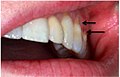 Abfraction lesion on a tooth
 -
 Example of a cervical lesion
 -
 Close-up of an abfraction lesion


