Turkish delight: Difference between revisions
CSV import Tags: mobile edit mobile web edit |
CSV import |
||
| Line 1: | Line 1: | ||
{{short description|A confectionery made from starch and sugar}} | |||
{{Use dmy dates|date=October 2023}} | |||
'''Turkish delight''' ({{lang-tr|lokum}}) is a family of confections based on a gel of starch and sugar. The confection is often flavored with rosewater, mastic, bergamot orange, or lemon. Premium varieties consist largely of chopped dates, pistachios, and hazelnuts or walnuts bound by the gel. The confection is often packaged and eaten in small cubes dusted with icing sugar, copra, or powdered cream of tartar to prevent clinging. | |||
The | |||
== | ==History== | ||
The | The exact origin of Turkish delight is not well documented, but it is known to have been produced in Turkey as early as the late 18th century. The confection is believed to have been invented by Bekir Efendi, who opened a confectionery shop in Istanbul in 1777. The sweet quickly gained popularity in the Ottoman Empire and later spread to Europe, where it became known as "Turkish delight." | ||
== | ==Preparation== | ||
The traditional method of making Turkish delight involves boiling sugar and water together, then adding starch and cream of tartar to form a thick, sticky mixture. This mixture is then flavored and colored before being poured into a mold to set. Once set, the confection is cut into small cubes and dusted with powdered sugar or desiccated coconut to prevent sticking. | |||
== | ==Varieties== | ||
Turkish | Turkish delight comes in a variety of flavors and textures. Common flavors include rose, lemon, and orange, while more exotic varieties may include pomegranate, mint, or cinnamon. Some versions incorporate nuts such as pistachios, hazelnuts, or walnuts, adding a crunchy texture to the otherwise soft and chewy sweet. | ||
== | ==Cultural significance== | ||
* [[ | Turkish delight holds a special place in Turkish culture and is often served as a gesture of hospitality. It is commonly enjoyed with coffee or tea and is a popular gift during holidays and special occasions. The confection has also gained international recognition and is enjoyed in many countries around the world. | ||
* [[ | |||
* [[ | ==Gallery== | ||
<gallery> | |||
File:TurkishDelightDisplay.jpg|A display of various Turkish delights | |||
File:Turkish_Delight.JPG|Traditional Turkish delight | |||
File:T_Honey.jpg|Honey-flavored Turkish delight | |||
File:Turkish_delight_surrounded_by_layers_of_nougat_and_dried_apricot.jpg|Turkish delight with nougat and dried apricot | |||
File:KaymakLokum_(3).JPG|Kaymak-flavored Turkish delight | |||
File:Rahat_cu_aroma_de_fructe.jpg|Fruit-flavored Turkish delight | |||
File:Armenian_Cigarette_Cookies.jpg|Armenian cigarette cookies with Turkish delight | |||
File:Sweets_on_Spice_Bazaar_in_Istanbul_02.jpg|Sweets at the Spice Bazaar in Istanbul | |||
File:Sweets_on_Spice_Bazaar_in_Istanbul_07.jpg|Various sweets including Turkish delight | |||
</gallery> | |||
==Related pages== | |||
* [[Baklava]] | |||
* [[Halva]] | |||
* [[Nougat]] | |||
==References== | |||
{{reflist}} | |||
[[Category:Turkish cuisine]] | [[Category:Turkish cuisine]] | ||
[[Category:Confectionery]] | [[Category:Confectionery]] | ||
[[Category:Ottoman cuisine]] | |||
Revision as of 00:38, 10 February 2025
A confectionery made from starch and sugar
Turkish delight (Turkish: lokum
) is a family of confections based on a gel of starch and sugar. The confection is often flavored with rosewater, mastic, bergamot orange, or lemon. Premium varieties consist largely of chopped dates, pistachios, and hazelnuts or walnuts bound by the gel. The confection is often packaged and eaten in small cubes dusted with icing sugar, copra, or powdered cream of tartar to prevent clinging.
History
The exact origin of Turkish delight is not well documented, but it is known to have been produced in Turkey as early as the late 18th century. The confection is believed to have been invented by Bekir Efendi, who opened a confectionery shop in Istanbul in 1777. The sweet quickly gained popularity in the Ottoman Empire and later spread to Europe, where it became known as "Turkish delight."
Preparation
The traditional method of making Turkish delight involves boiling sugar and water together, then adding starch and cream of tartar to form a thick, sticky mixture. This mixture is then flavored and colored before being poured into a mold to set. Once set, the confection is cut into small cubes and dusted with powdered sugar or desiccated coconut to prevent sticking.
Varieties
Turkish delight comes in a variety of flavors and textures. Common flavors include rose, lemon, and orange, while more exotic varieties may include pomegranate, mint, or cinnamon. Some versions incorporate nuts such as pistachios, hazelnuts, or walnuts, adding a crunchy texture to the otherwise soft and chewy sweet.
Cultural significance
Turkish delight holds a special place in Turkish culture and is often served as a gesture of hospitality. It is commonly enjoyed with coffee or tea and is a popular gift during holidays and special occasions. The confection has also gained international recognition and is enjoyed in many countries around the world.
Gallery
-
 A display of various Turkish delights
 -
 Traditional Turkish delight
 -
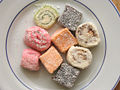 Honey-flavored Turkish delight
 -
 Turkish delight with nougat and dried apricot
 -
 Kaymak-flavored Turkish delight
 -
 Fruit-flavored Turkish delight
 -
 Armenian cigarette cookies with Turkish delight
 -
 Sweets at the Spice Bazaar in Istanbul
 -
 Various sweets including Turkish delight


.JPG)


Related pages
References
<references group="" responsive="1"></references>
