Electrolytic cell: Difference between revisions
No edit summary |
CSV import |
||
| Line 39: | Line 39: | ||
{{Electrolysis}} | {{Electrolysis}} | ||
{{medicine-stub}} | {{medicine-stub}} | ||
<gallery> | |||
File:Electrolyser 1884.png|Electrolyser 1884 | |||
</gallery> | |||
Revision as of 17:50, 3 March 2025
Device that uses electrical energy to drive a non-spontaneous chemical reaction
An electrolytic cell is a type of electrochemical cell that uses electrical energy to drive a non-spontaneous chemical reaction. This process is known as electrolysis. Electrolytic cells are used in various industrial applications, including the extraction of metals from their ores, electroplating, and the production of chemicals.
Components
An electrolytic cell consists of three main components:
- **Electrolyte**: A substance containing free ions that carry electric current. The electrolyte can be a molten ionic compound or an aqueous solution.
- **Anode**: The electrode where oxidation occurs. In an electrolytic cell, the anode is connected to the positive terminal of the power supply.
- **Cathode**: The electrode where reduction occurs. The cathode is connected to the negative terminal of the power supply.
Working Principle
When an external electric current is applied to the electrolytic cell, it forces the non-spontaneous chemical reaction to occur. The power supply provides the necessary energy to drive the reaction. At the anode, oxidation takes place, releasing electrons into the external circuit. At the cathode, reduction occurs, consuming electrons from the external circuit.
Applications
Electrolytic cells have a wide range of applications, including:
- **Electroplating**: The process of depositing a thin layer of metal onto the surface of another material. This is commonly used to improve corrosion resistance, reduce friction, or enhance appearance.
- **Electrorefining**: The purification of metals by electrolysis. For example, copper is purified using an electrolytic cell.
- **Electrolysis of water**: The decomposition of water into oxygen and hydrogen gas. This process is used to produce hydrogen fuel.
- **Chlor-alkali process**: The production of chlorine and sodium hydroxide by the electrolysis of brine (sodium chloride solution).
Examples
Some common examples of electrolytic cells include:
- **Downs cell**: Used for the production of metallic sodium and chlorine gas from molten sodium chloride.
- **Hall-Héroult process**: Used for the extraction of aluminum from its ore, bauxite, through the electrolysis of molten aluminum oxide.
See also
References
| Articles related to electrolysis / Standard electrode potential | ||||||
|---|---|---|---|---|---|---|
|

-
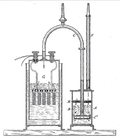 Electrolyser 1884

