Algae bioreactor: Difference between revisions
CSV import |
CSV import |
||
| Line 8: | Line 8: | ||
File:IBA_Hamburg_BIQ_(2).nnw.jpg|BIQ building with algae bioreactor facade | File:IBA_Hamburg_BIQ_(2).nnw.jpg|BIQ building with algae bioreactor facade | ||
</gallery> | </gallery> | ||
== Algae Bioreactor == | |||
An '''algae bioreactor''' is a system designed to cultivate [[algae]] for various purposes, including [[biofuel]] production, [[carbon dioxide]] sequestration, and [[wastewater treatment]]. Algae bioreactors are a type of [[bioreactor]] that specifically focus on the growth and harvesting of algae, which are photosynthetic organisms capable of converting sunlight, carbon dioxide, and nutrients into biomass. | |||
== Design and Components == | |||
Algae bioreactors can be designed in various configurations, including open ponds and closed systems. The choice of design depends on factors such as the intended application, environmental conditions, and cost considerations. | |||
=== Open Pond Systems === | |||
Open pond systems are the simplest form of algae cultivation. They consist of shallow ponds where algae are grown in a natural or semi-controlled environment. These systems are cost-effective but are susceptible to contamination and environmental fluctuations. | |||
=== Closed Systems === | |||
Closed systems, such as [[photobioreactors]], provide a controlled environment for algae cultivation. These systems are enclosed, allowing for better control over growth conditions such as light, temperature, and nutrient supply. Photobioreactors can be designed in various forms, including tubular, flat-panel, and columnar configurations. | |||
== Applications == | |||
Algae bioreactors have several applications across different industries: | |||
=== Biofuel Production === | |||
Algae are considered a promising source of [[biofuel]] due to their high lipid content and rapid growth rates. Algae bioreactors can be used to produce [[biodiesel]], [[bioethanol]], and other renewable fuels. | |||
=== Carbon Dioxide Sequestration === | |||
Algae bioreactors can help mitigate [[climate change]] by capturing and utilizing carbon dioxide from industrial emissions. The photosynthetic process of algae converts carbon dioxide into organic matter, reducing the overall carbon footprint. | |||
=== Wastewater Treatment === | |||
Algae bioreactors can be integrated into [[wastewater treatment]] systems to remove nutrients and contaminants. Algae can absorb [[nitrogen]], [[phosphorus]], and heavy metals, improving water quality and reducing pollution. | |||
== Challenges == | |||
Despite their potential, algae bioreactors face several challenges: | |||
* '''Contamination:''' Open systems are prone to contamination by unwanted microorganisms, which can affect algae growth and productivity. | |||
* '''Cost:''' The initial setup and maintenance of closed systems can be expensive, limiting their widespread adoption. | |||
* '''Scalability:''' Scaling up algae bioreactor systems to industrial levels remains a significant challenge due to technical and economic constraints. | |||
== Future Prospects == | |||
Research and development in algae bioreactor technology continue to advance, with efforts focused on improving efficiency, reducing costs, and enhancing scalability. Innovations in genetic engineering, system design, and process optimization hold promise for the future of algae-based technologies. | |||
== Related Pages == | |||
* [[Bioreactor]] | |||
* [[Photobioreactor]] | |||
* [[Biofuel]] | |||
* [[Carbon dioxide sequestration]] | |||
* [[Wastewater treatment]] | |||
{{Biotechnology}} | |||
{{Renewable energy}} | |||
[[Category:Biotechnology]] | |||
[[Category:Renewable energy technology]] | |||
[[Category:Algae cultivation]] | |||
Latest revision as of 00:35, 19 February 2025
Algae_bioreactor[edit]
-
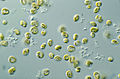 Microalgae in a laboratory setting
 -
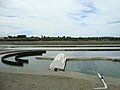 Algae to biofuels demonstration
 -
 Photobioreactor PBR 500 P
 -
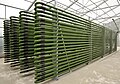 Photobioreactor PBR 4000 G
 -
 Bubble column photobioreactor
 -
 BIQ building with algae bioreactor facade


.nnw.jpg)
Algae Bioreactor[edit]
An algae bioreactor is a system designed to cultivate algae for various purposes, including biofuel production, carbon dioxide sequestration, and wastewater treatment. Algae bioreactors are a type of bioreactor that specifically focus on the growth and harvesting of algae, which are photosynthetic organisms capable of converting sunlight, carbon dioxide, and nutrients into biomass.
Design and Components[edit]
Algae bioreactors can be designed in various configurations, including open ponds and closed systems. The choice of design depends on factors such as the intended application, environmental conditions, and cost considerations.
Open Pond Systems[edit]
Open pond systems are the simplest form of algae cultivation. They consist of shallow ponds where algae are grown in a natural or semi-controlled environment. These systems are cost-effective but are susceptible to contamination and environmental fluctuations.
Closed Systems[edit]
Closed systems, such as photobioreactors, provide a controlled environment for algae cultivation. These systems are enclosed, allowing for better control over growth conditions such as light, temperature, and nutrient supply. Photobioreactors can be designed in various forms, including tubular, flat-panel, and columnar configurations.
Applications[edit]
Algae bioreactors have several applications across different industries:
Biofuel Production[edit]
Algae are considered a promising source of biofuel due to their high lipid content and rapid growth rates. Algae bioreactors can be used to produce biodiesel, bioethanol, and other renewable fuels.
Carbon Dioxide Sequestration[edit]
Algae bioreactors can help mitigate climate change by capturing and utilizing carbon dioxide from industrial emissions. The photosynthetic process of algae converts carbon dioxide into organic matter, reducing the overall carbon footprint.
Wastewater Treatment[edit]
Algae bioreactors can be integrated into wastewater treatment systems to remove nutrients and contaminants. Algae can absorb nitrogen, phosphorus, and heavy metals, improving water quality and reducing pollution.
Challenges[edit]
Despite their potential, algae bioreactors face several challenges:
- Contamination: Open systems are prone to contamination by unwanted microorganisms, which can affect algae growth and productivity.
- Cost: The initial setup and maintenance of closed systems can be expensive, limiting their widespread adoption.
- Scalability: Scaling up algae bioreactor systems to industrial levels remains a significant challenge due to technical and economic constraints.
Future Prospects[edit]
Research and development in algae bioreactor technology continue to advance, with efforts focused on improving efficiency, reducing costs, and enhancing scalability. Innovations in genetic engineering, system design, and process optimization hold promise for the future of algae-based technologies.
Related Pages[edit]
| Biotechnology | ||||||||||
|---|---|---|---|---|---|---|---|---|---|---|
|
| Part of a series on |
| Renewable energy |
|---|
 |
