Acacia sensu lato: Difference between revisions
CSV import |
CSV import Tags: mobile edit mobile web edit |
||
| Line 41: | Line 41: | ||
[[Category:Acacia|*]] | [[Category:Acacia|*]] | ||
<gallery> | |||
File:Acacia_greggii_thorns.jpg|Acacia sensu lato | |||
File:Acacia_Negev.JPG|Acacia sensu lato | |||
File:Acacia_pycnantha_Golden_Wattle.jpg|Acacia sensu lato | |||
File:Acacia_sp._MHNT.BOT.2009.13.18.jpg|Acacia sensu lato | |||
File:Acacia_facsiculifera_seedling.jpg|Acacia sensu lato | |||
File:Acacia_collinsii3.jpg|Acacia sensu lato | |||
File:Acacia_drepanolobium_MHNT.BOT.2011.3.97.jpg|Acacia sensu lato | |||
File:Acacia_dealbata_seeds.jpg|Acacia sensu lato | |||
File:Acaciasap.jpg|Acacia sensu lato | |||
File:Acaciafarnesiana1web.jpg|Acacia sensu lato | |||
File:Philae_Temple_Egypt_Goddess_Isis_As_Angel_Mural_Artwork_2004-10-11.jpg|Acacia sensu lato | |||
File:Starr_030405-0092_Acacia_koa.jpg|Acacia sensu lato | |||
</gallery> | |||
Revision as of 12:20, 18 February 2025
Acacia sensu lato


Acacia sensu lato refers to a broad group of Acacia species that were traditionally classified under the genus Acacia. This group includes a wide variety of species found across different continents, particularly in Australia, Africa, and the Americas.
Taxonomy
The genus Acacia was originally described by the Swedish botanist Carl Linnaeus in 1754. Over time, the genus has undergone significant taxonomic revisions. In recent years, the genus has been split into several genera, including Vachellia, Senegalia, and others, due to differences in morphology and genetic studies.
Morphology
Acacias are known for their distinctive thorns or spines, which are a common feature among many species. These thorns serve as a defense mechanism against herbivores. The leaves of Acacia species are typically bipinnate, although some species have evolved phyllodes, which are flattened leaf stalks that function like leaves.
Distribution
Acacia species are widely distributed across the tropics and subtropics. In Australia, Acacias are commonly referred to as "wattles" and are a dominant component of the flora. In Africa, Acacias are often found in savanna ecosystems, where they play a crucial role in the ecology of the region.
Ecological Role
Acacias are important for their ecological roles, providing habitat and food for a variety of wildlife. They are also known for their symbiotic relationship with nitrogen-fixing bacteria, which allows them to thrive in nutrient-poor soils.
Uses
Acacias have numerous uses, ranging from timber and fuelwood to gum production. The gum arabic produced by some African Acacia species is a valuable commodity used in the food and pharmaceutical industries. In Australia, the Golden Wattle (Acacia pycnantha) is the national floral emblem.
Gallery
-
 Acacia species
 -
 Acacia fasciculifera seedling
 -
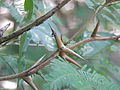 Acacia collinsii
 -
 Acacia drepanolobium
 -
 Acacia dealbata seeds
 -
 Acacia sap
 -
 Acacia farnesiana
 -
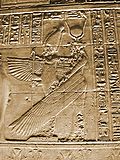 Acacia in ancient Egyptian art


Related pages
-
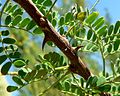 Acacia sensu lato
 -
 Acacia sensu lato
 -
 Acacia sensu lato
 -
Acacia sensu lato
-
Acacia sensu lato
-
Acacia sensu lato
-
Acacia sensu lato
-
Acacia sensu lato
-
Acacia sensu lato
-
Acacia sensu lato
-
Acacia sensu lato
-
 Acacia sensu lato

