2-Hydroxyglutaric aciduria: Difference between revisions
CSV import |
CSV import |
||
| Line 56: | Line 56: | ||
[[Category:Rare diseases]] | [[Category:Rare diseases]] | ||
[[Category:Genetic disorders]] | [[Category:Genetic disorders]] | ||
<gallery> | |||
File:Alpha-hydroxyglutaric_acid.png|2-Hydroxyglutaric aciduria | |||
File:Autorecessive.svg|Autosomal recessive inheritance pattern | |||
</gallery> | |||
Revision as of 00:57, 18 February 2025
A rare metabolic disorder
Template:Medical condition (new)
2-Hydroxyglutaric aciduria is a rare metabolic disorder characterized by the accumulation of 2-hydroxyglutaric acid in the urine. This condition is caused by a deficiency in the enzymes responsible for the metabolism of 2-hydroxyglutarate, leading to its accumulation in the body.
Classification
2-Hydroxyglutaric aciduria is classified into three main types based on the specific form of 2-hydroxyglutarate that accumulates:
- L-2-hydroxyglutaric aciduria
- D-2-hydroxyglutaric aciduria
- Combined D-2- and L-2-hydroxyglutaric aciduria
Each type is associated with different genetic mutations and clinical presentations.
Genetics
The disorder is inherited in an autosomal recessive manner. This means that an individual must inherit two copies of the mutated gene, one from each parent, to be affected by the condition. The specific genes involved vary depending on the type of 2-hydroxyglutaric aciduria.
Pathophysiology
In 2-hydroxyglutaric aciduria, the accumulation of 2-hydroxyglutarate interferes with normal cellular metabolism. This can lead to neurological symptoms due to the toxic effects of the metabolite on the central nervous system.
Clinical Features
The clinical presentation of 2-hydroxyglutaric aciduria can vary widely, but common symptoms include:
Diagnosis
Diagnosis is typically made through the detection of elevated levels of 2-hydroxyglutaric acid in the urine using gas chromatography-mass spectrometry (GC-MS). Genetic testing can confirm the specific type of 2-hydroxyglutaric aciduria by identifying mutations in the relevant genes.
Treatment
There is currently no cure for 2-hydroxyglutaric aciduria. Treatment is primarily supportive and may include:
- Anticonvulsants for seizure management
- Physical therapy to improve motor skills
- Occupational therapy
Prognosis
The prognosis for individuals with 2-hydroxyglutaric aciduria varies depending on the type and severity of the condition. Early diagnosis and supportive care can improve quality of life and outcomes.
Related pages
Gallery
-
 Structure of 2-hydroxyglutaric acid

-
2-Hydroxyglutaric aciduria
-
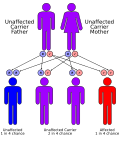 Autosomal recessive inheritance pattern

