Biblical Magi: Difference between revisions
No edit summary |
CSV import |
||
| Line 29: | Line 29: | ||
{{nt}} | {{nt}} | ||
{{christianity-stub}} | {{christianity-stub}} | ||
<gallery> | |||
File:Magi (1).jpg|Magi (1) | |||
File:Biblical Magi stained glass window, ca. 1896, Church of the Good Shepherd (Rosemont, Pennsylvania).jpg|Biblical Magi stained glass window, ca. 1896, Church of the Good Shepherd (Rosemont, Pennsylvania) | |||
File:XV14 - Roma, Museo civiltà romana - Adorazione dei Magi - sec III dC - Foto Giovanni Dall'Orto 12-Apr-2008.jpg|Adorazione dei Magi - sec III dC | |||
File:The three Magi (Balthasar, Caspar, Melchior).jpg|The three Magi (Balthasar, Caspar, Melchior) | |||
File:Brooklyn Museum - The Magi Journeying (Les rois mages en voyage) - James Tissot - overall.jpg|The Magi Journeying (Les rois mages en voyage) - James Tissot | |||
File:Three kings.tif|Three kings | |||
File:Caspar by Jan van Bijlert.jpg|Caspar by Jan van Bijlert | |||
File:Gold Coin of Heiliodotos.jpg|Gold Coin of Heiliodotos | |||
File:Olibanum resin.jpg|Olibanum resin | |||
File:Commiphora-myrrha-resin-myrrh.jpg|Commiphora myrrha resin myrrh | |||
</gallery> | |||
Latest revision as of 05:44, 3 March 2025
| Part of a series on |
| Christianity |
|---|
| Principal symbol of Christianity |
The Biblical Magi also known as Three Wise Men or Three Kings, were, in the Gospel of Matthew and Christian tradition, distinguished foreigners who visited Jesus after his birth, bearing gifts of gold, frankincense, and myrrh. They are regular figures in traditional accounts of the nativity celebrations of Christmas and are an important part of Christian tradition.
Origin[edit]
The word Magi is a term, used since at least the 4th century BC, for followers of Zoroastrianism or Zoroaster. The Magi are described as "wise men from the East" in the Gospel of Matthew and are traditionally said to have visited Jesus after his birth.
Gifts[edit]
The Magi are popularly referred to as wise men and kings. The word magi is the plural of Latin magus, borrowed from Greek μάγος magos, as used in the original Greek text of the Gospel of Matthew (in the plural: μάγοι). The gifts of the Magi (gold, frankincense, and myrrh) are somewhat mysterious in their symbolism. Gold is a traditional symbol of kingship on earth, frankincense (an incense) is a symbol of deity, and myrrh (an embalming oil) is a symbol of death.
In Christian Tradition[edit]
In Western Christianity, the feast that commemorates the visit of the Magi, Epiphany, is celebrated on January 6. In these churches, the day begins the liturgical season of Epiphanytide, which lasts until Ash Wednesday.
In Art and Music[edit]
The Biblical Magi have been a popular subject in Christian art and music. They have been depicted in numerous works of art, such as paintings and sculptures, and their journey to visit the Christ Child has been the theme of many traditional Christmas carols.
See Also[edit]
This article is a Christianity-related stub. You can help WikiMD by expanding it!
-
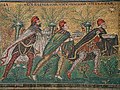 Magi (1)
 -
Biblical Magi stained glass window, ca. 1896, Church of the Good Shepherd (Rosemont, Pennsylvania)
-
Adorazione dei Magi - sec III dC
-
The three Magi (Balthasar, Caspar, Melchior)
-
The Magi Journeying (Les rois mages en voyage) - James Tissot
-
Three kings
-
Caspar by Jan van Bijlert
-
Gold Coin of Heiliodotos
-
Olibanum resin
-
Commiphora myrrha resin myrrh
.jpg)


.jpg)

.jpg)
_-_James_Tissot_-_overall.jpg)


