Rosemary: Difference between revisions
CSV import |
CSV import |
||
| Line 28: | Line 28: | ||
{{food-stub}} | {{food-stub}} | ||
{{nt}} | {{nt}} | ||
<gallery> | |||
File:Rosemary in bloom.JPG|Rosemary in bloom | |||
File:RosemarySprig.jpg|Rosemary sprig | |||
File:Rosmarinus officinalis prostratus.jpg|Rosmarinus officinalis prostratus | |||
File:Rosemary Plant.jpg|Rosemary plant | |||
File:Rosemary, ca 1500.jpg|Rosemary, ca 1500 | |||
File:Koeh-258.jpg|Koehler's Medicinal Plants - Rosemary | |||
File:Rosmarinus officinalis MHNT.BOT.2008.1.19.jpg|Rosmarinus officinalis specimen | |||
File:Rosemary (রোজমেরী).JPG|Rosemary | |||
File:RosemaryEssentialOil.png|Rosemary essential oil | |||
</gallery> | |||
Revision as of 01:31, 20 February 2025
Rosemary (Rosmarinus officinalis) is a fragrant evergreen herb native to the Mediterranean region. It is used in cooking, as an aromatic essential oil, and in herbal medicine. The plant is also appreciated for its decorative qualities in gardens and landscapes.
Description
Rosemary is a perennial plant growing to 1–2 meters in height, with dense, needle-like leaves that are rich in aromatic oils. The leaves are dark green on the top and pale green on the underside. It blooms in spring and summer, producing small, blue, white, or pink flowers.
Cultivation
Rosemary thrives in a sunny, well-drained environment and is tolerant of drought, making it a popular plant in xeriscaping. It can be propagated from seeds, cuttings, or dividing rooted sections of the plant. In regions with harsh winters, rosemary can be grown in containers and moved indoors to protect from freezing temperatures.
Culinary Uses
In cuisine, rosemary is used as a herb to flavor various dishes, such as meats, soups, and sauces. It is known for its strong, pine-like aroma and flavor. Rosemary is also used in the preparation of herbal teas and can be found in several culinary and herbal blends.
Medicinal Uses
Historically, rosemary has been used for its medicinal properties, including improving memory, aiding digestion, and providing anti-inflammatory and antioxidant benefits. However, scientific evidence supporting these claims is limited.
Cultural Significance
Rosemary has held cultural significance in many societies. It has been used in wedding ceremonies, culinary traditions, and as a symbol of remembrance during war commemorations.
See Also

-
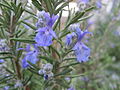 Rosemary in bloom
 -
 Rosemary sprig
 -
 Rosmarinus officinalis prostratus
 -
 Rosemary plant
 -
 Rosemary, ca 1500
 -
 Koehler's Medicinal Plants - Rosemary
 -
 Rosmarinus officinalis specimen
 -
 Rosemary
 -
 Rosemary essential oil


.JPG)

