Cane toad: Difference between revisions
CSV import |
CSV import |
||
| Line 53: | Line 53: | ||
[[Category:Amphibians of Central America]] | [[Category:Amphibians of Central America]] | ||
[[Category:Amphibians of South America]] | [[Category:Amphibians of South America]] | ||
<gallery> | |||
File:Cane_toad_(Rhinella_marina)_Taveuni.jpg|Cane toad in Taveuni | |||
File:Cane-toad.jpg|Cane toad | |||
File:Young_Bufo_marinus.jpg|Young Bufo marinus | |||
File:CSIRO_ScienceImage_1842_Cane_Toad_Spawn.jpg|Cane toad spawn | |||
File:Bufo_marinus01e.jpg|Bufo marinus | |||
File:Kookaburra_with_Cane_Toad_-_AndrewMercer_-_DSC00046.jpg|Kookaburra with Cane Toad | |||
File:Bufo_marinus_(Philippines).jpg|Bufo marinus in the Philippines | |||
File:Cane_Toad_Products.jpg|Cane Toad Products | |||
</gallery> | |||
Revision as of 11:36, 18 February 2025
The Cane Toad (Rhinella marina), also known as the Giant Neotropical Toad or Marine Toad, is a large, terrestrial true toad native to Central and South America. It has been introduced to various regions, including Australia, where it is considered an invasive species.
Description
Cane toads are robust amphibians with a dry, warty skin. They can grow up to 15 cm (6 inches) in length, with females generally larger than males. Their coloration varies from grey to olive-brown, with a lighter underbelly. Cane toads have large parotoid glands behind their eyes, which secrete a potent toxin.
Habitat and Distribution
Cane toads are highly adaptable and can thrive in a variety of environments, including forests, grasslands, and urban areas. They are native to Central and South America but have been introduced to other regions such as the Caribbean, the Philippines, and Australia.
Ecological Impact
In regions where they have been introduced, cane toads have had significant ecological impacts. In Australia, they were introduced in 1935 to control agricultural pests but have since become a major pest themselves. They compete with native species for food and habitat and their toxins can be lethal to predators that attempt to eat them.
Toxicity
Cane toads produce a toxin called bufotoxin, which is secreted from their parotoid glands. This toxin can cause serious harm or death to animals that ingest it. The toxin affects the heart and can cause convulsions, paralysis, and death.
Reproduction
Cane toads breed in a variety of water bodies, from ponds to ditches. Females lay thousands of eggs in long strings, which hatch into tadpoles within a few days. The tadpoles undergo metamorphosis into juvenile toads over several weeks.
Control and Management
Efforts to control cane toad populations include physical removal, habitat modification, and research into biological control methods. Public awareness campaigns also aim to reduce the spread of cane toads by educating people about their impact and how to manage them.
Also see
References
<references />
| Extant amphibian positions by subclass | ||
|---|---|---|
|
| Invasive species | ||||||||||
|---|---|---|---|---|---|---|---|---|---|---|
This invasive species related article is a stub.
|
-
 Cane toad in Taveuni
 -
 Cane toad
 -
 Young Bufo marinus
 -
 Cane toad spawn
 -
 Bufo marinus
 -
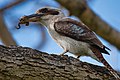 Kookaburra with Cane Toad
 -
 Bufo marinus in the Philippines
 -
 Cane Toad Products
_Taveuni.jpg)


.jpg)

