Flerovium: Difference between revisions
CSV import Tags: mobile edit mobile web edit |
CSV import |
||
| Line 25: | Line 25: | ||
[[Category:Synthetic elements]] | [[Category:Synthetic elements]] | ||
{{Element-stub}} | {{Element-stub}} | ||
<gallery> | |||
File:RUSMARKA-1660.jpg|Flerovium | |||
File:IBA_nuclear_shells.svg|Nuclear shell model diagram | |||
File:Next_proton_shell.svg|Proton shell model diagram | |||
</gallery> | |||
Latest revision as of 01:54, 18 February 2025
Flerovium is a chemical element with the symbol Fl and atomic number 114. It is a superheavy element in the periodic table, belonging to the p-block and is a member of the 7th period and group 14 elements, also known as the carbon group. Flerovium is a synthetic element, meaning it is not found in nature but has to be created in a laboratory through the fusion of lighter atoms. Its most stable known isotope, flerovium-289, has a half-life of about 2.6 seconds, although this may vary slightly for other isotopes.
Discovery[edit]
Flerovium was first synthesized in December 1998 at the Joint Institute for Nuclear Research (JINR) in Dubna, Russia, by a team of Russian scientists led by Yuri Oganessian. The team bombarded atoms of plutonium-244 with ions of calcium-48, leading to the creation of flerovium-289 after emitting a couple of neutrons. The discovery was a significant milestone in the field of nuclear physics and chemistry, contributing to the understanding of the properties of superheavy elements.
Properties[edit]
Due to its extremely short half-life, studying flerovium's properties is challenging. Theoretical predictions suggest that flerovium may exhibit some properties similar to its lighter homologs, such as lead and tin, but with significant differences due to relativistic effects. These effects are particularly pronounced in superheavy elements and can lead to unexpected chemical and physical properties. For instance, flerovium is predicted to be a relatively inert, noble metal, possibly even more so than lead, contradicting earlier expectations that it would behave similarly to tin.
Naming[edit]
The name "flerovium" honors the Flerov Laboratory of Nuclear Reactions of JINR, itself named after the Soviet physicist Georgy Flyorov, who is known for his discovery of spontaneous fission. The name was officially adopted by the International Union of Pure and Applied Chemistry (IUPAC) in 2012, following the tradition of naming elements after their discoverers or places of discovery.
Applications[edit]
As of now, flerovium has no practical applications outside of scientific research due to its short half-life and the difficulty in producing it in significant quantities. The primary interest in flerovium and other superheavy elements lies in the insights they provide into the limits of the periodic table, the stability of nuclei, and the behavior of matter under extreme conditions.
See Also[edit]
References[edit]
<references/>

This chemical element related article is a stub. You can help WikiMD by expanding it.
-
 Flerovium
 -
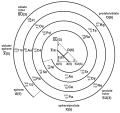 Nuclear shell model diagram
 -
 Proton shell model diagram


