Benzisothiazolinone: Difference between revisions
CSV import |
CSV import |
||
| Line 29: | Line 29: | ||
{{Chemical-compound-stub}} | {{Chemical-compound-stub}} | ||
{{medicine-stub}} | {{medicine-stub}} | ||
<gallery> | |||
File:Benzisothiazolinone.svg|Benzisothiazolinone.svg | |||
File:Benzisothiazolinone-from-xtal-3D-bs-17.png|Benzisothiazolinone-from-xtal-3D-bs-17.png | |||
</gallery> | |||
Latest revision as of 11:32, 25 February 2025
Benzisothiazolinone (BIT) is a type of biocide that is often used in the chemical industry to restrict the growth of microorganisms in products. It is a powerful fungicide and bactericide, making it a common choice for preserving industrial products such as paints, emulsions, and adhesives.
Chemical Structure and Properties[edit]
Benzisothiazolinone is an organic compound with the chemical formula C7H5NOS. It is a white to pale yellow solid with a slight, characteristic odor. The compound is soluble in water and most organic solvents. Its molecular weight is 151.19 g/mol.
Uses[edit]
Benzisothiazolinone is primarily used as a preservative in a variety of industrial applications. It is effective against a broad spectrum of microorganisms, including bacteria, yeast, and mold. It is commonly used in:
- Paints and Coatings: BIT is used to prevent microbial degradation and extend the shelf life of these products.
- Adhesives and Sealants: It is used to prevent microbial growth that can affect the performance of these products.
- Construction Materials: BIT is used in materials such as concrete and plaster to prevent microbial growth.
Health Effects[edit]
Exposure to benzisothiazolinone can cause allergic reactions, including skin irritation and contact dermatitis. It is also harmful if swallowed or inhaled, and can cause serious eye damage. Therefore, it is important to handle this chemical with care and use appropriate personal protective equipment.
Regulation[edit]
In the European Union, the use of benzisothiazolinone in cosmetic products has been restricted due to its potential to cause skin allergies. In the United States, the Environmental Protection Agency (EPA) regulates the use of BIT in certain applications.
See Also[edit]
This article is a Chemical compound-related stub. You can help WikiMD by expanding it!

-
 Benzisothiazolinone.svg
 -
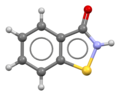 Benzisothiazolinone-from-xtal-3D-bs-17.png


