Zinc transporter SLC39A7: Difference between revisions
CSV import |
CSV import |
||
| Line 27: | Line 27: | ||
{{protein-stub}} | {{protein-stub}} | ||
{{medicine-stub}} | {{medicine-stub}} | ||
<gallery> | |||
File:Full_3D_Alpha_Fold_Structure_of_ZIP7.png|Full 3D Alpha Fold Structure of ZIP7 | |||
File:Zoomed_in_3D_Alpha_Fold_Structure_of_ZIP7.png|Zoomed in 3D Alpha Fold Structure of ZIP7 | |||
</gallery> | |||
Latest revision as of 01:13, 18 February 2025
Zinc transporter SLC39A7, also known as ZIP7, is a protein that in humans is encoded by the SLC39A7 gene. This protein is a member of the SLC39 family of solute carriers.
Function[edit]
SLC39A7 is a zinc transporter that facilitates the transport of zinc from the cytoplasm into the endoplasmic reticulum. Zinc is an essential trace element that is vital for many biological processes, including enzyme function, protein synthesis, and cell division.
Structure[edit]
The SLC39A7 protein is a transmembrane protein, meaning it spans the membrane of the endoplasmic reticulum. It has eight predicted transmembrane domains and a histidine-rich loop, which is thought to be involved in zinc binding.
Clinical significance[edit]
Mutations in the SLC39A7 gene have been associated with various health conditions. For example, a study found that a mutation in this gene was associated with hypoparathyroidism, deafness, and renal disease (HDR syndrome).
See also[edit]
References[edit]
<references />
External links[edit]


-
 Full 3D Alpha Fold Structure of ZIP7
 -
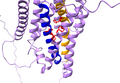 Zoomed in 3D Alpha Fold Structure of ZIP7


