Bacterial cellular morphologies: Difference between revisions
CSV import Tags: mobile edit mobile web edit |
CSV import |
||
| Line 38: | Line 38: | ||
{{anatomy-stub}} | {{anatomy-stub}} | ||
== Bacterial cellular morphologies gallery == | |||
<gallery> | |||
File:Bacterial morphology diagram.svg|Bacterial morphology diagram | |||
File:Arrangement of cocci bacteria en.svg|Arrangement of cocci bacteria | |||
File:Staphylococcus aureus Gram.jpg|Staphylococcus aureus Gram stain | |||
File:Cocci arrangement.png|Cocci arrangement | |||
File:Coxiella burnetii 01.JPG|Coxiella burnetii | |||
File:ARS Campylobacter jejuni.jpg|Campylobacter jejuni | |||
File:Treponema pallidum.jpg|Treponema pallidum | |||
</gallery> | |||
Latest revision as of 05:53, 3 March 2025
Bacterial Cellular Morphologies
Bacterial cellular morphologies refer to the various shapes and structural forms of bacteria. Bacteria are single-celled microorganisms that come in a variety of shapes and sizes. The three most common shapes are coccus (spherical), bacillus (rod-shaped), and spirillum (spiral).
Coccus[edit]
Coccus bacteria are spherical in shape. They can exist as single cells or can group together in pairs (diplococci), chains (streptococci), or clusters (staphylococci). Examples of coccus bacteria include Staphylococcus aureus and Streptococcus pneumoniae.
Bacillus[edit]
Bacillus bacteria are rod-shaped. They can exist as single cells, in pairs (diplobacilli), or in chains (streptobacilli). Examples of bacillus bacteria include Escherichia coli and Bacillus anthracis.
Spirillum[edit]
Spirillum bacteria are spiral-shaped. They are usually found in stagnant water and in the human body. Examples of spirillum bacteria include Spirillum minus and Campylobacter jejuni.
Other Morphologies[edit]
In addition to the three most common shapes, bacteria can also take on other morphologies. For example, vibrio bacteria are comma-shaped, spirochete bacteria are long and tightly coiled, and pleomorphic bacteria can change their shape in response to their environment.
Importance of Bacterial Morphology[edit]
The shape of a bacterium can influence its pathogenicity, its ability to survive in different environments, and its mode of movement. For example, spiral-shaped bacteria can move more easily through viscous environments, such as mucus, than rod-shaped or spherical bacteria.
See Also[edit]
References[edit]
<references />

Bacterial cellular morphologies gallery[edit]
-
 Bacterial morphology diagram
 -
 Arrangement of cocci bacteria
 -
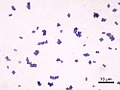 Staphylococcus aureus Gram stain
 -
 Cocci arrangement
 -
 Coxiella burnetii
 -
 Campylobacter jejuni
 -
 Treponema pallidum


