Lima bean: Difference between revisions
CSV import Tags: mobile edit mobile web edit |
CSV import |
||
| Line 37: | Line 37: | ||
[[Category:Edible legumes]] | [[Category:Edible legumes]] | ||
{{food-stub}} | {{food-stub}} | ||
<gallery> | |||
File:Phaseoulus_lunatus.jpg|Phaseoulus lunatus | |||
File:Lima_beans_in_an_illustrated_catalogue_of_seeds_(1894)_(17802859704).jpg|Lima beans in an illustrated catalogue of seeds (1894) | |||
File:Lima_Bean_Time_Lapse.webm|Lima Bean Time Lapse | |||
File:Speckled_butterbeans.jpg|Speckled butterbeans | |||
File:Garrofón._Concurso_Internacional_de_Paella_de_Sueca_2016_01.jpg|Garrofón. Concurso Internacional de Paella de Sueca 2016 | |||
File:Phaseolus_lunatus_MHNT.BOT.2008.1.40.jpg|Phaseolus lunatus MHNT.BOT.2008.1.40 | |||
File:Lima_bean_cans.jpg|Lima bean cans | |||
</gallery> | |||
Latest revision as of 21:42, 23 February 2025
Lima Bean
The Lima Bean (Phaseolus lunatus), also known as the butter bean, sieva bean, or Madagascar bean, is a legume grown for its edible seeds or beans.
Origin and Distribution[edit]
Lima Beans are believed to have originated in Central America or South America, where they have been cultivated for thousands of years. Today, they are grown worldwide, with the largest producers being the United States, China, and India.
Description[edit]
Lima Beans are annual plants with a bushy or vining growth habit. The leaves are trifoliate, and the flowers are white, yellow, or purple. The beans themselves are flat and kidney-shaped, with a buttery texture and mild flavor when cooked.
Cultivation[edit]
Lima Beans are a warm-season crop, requiring temperatures between 60 and 70 degrees Fahrenheit for optimal growth. They are typically planted in the spring after the last frost, and harvested in the late summer or early fall.
Nutritional Value[edit]
Lima Beans are a rich source of protein, dietary fiber, and various vitamins and minerals, including vitamin B6, magnesium, and iron. They are also low in fat and cholesterol, making them a healthy choice for those following a heart-healthy diet.
Culinary Uses[edit]
Lima Beans can be eaten fresh or dried, and are commonly used in soups, stews, and casseroles. They can also be mashed and used as a filling for tacos, burritos, and other Mexican dishes.
Health Risks[edit]
Raw Lima Beans contain linamarin, a compound that can release cyanide when consumed. However, cooking the beans thoroughly neutralizes this compound, making them safe to eat.
See Also[edit]

-
 Phaseoulus lunatus
 -
 Lima beans in an illustrated catalogue of seeds (1894)
 -
 Lima Bean Time Lapse
 -
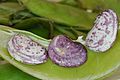 Speckled butterbeans
 -
 Garrofón. Concurso Internacional de Paella de Sueca 2016
 -
 Phaseolus lunatus MHNT.BOT.2008.1.40
 -
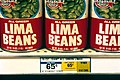 Lima bean cans

_(17802859704).jpg)


