Calvin cycle: Difference between revisions
CSV import Tags: mobile edit mobile web edit |
CSV import |
||
| Line 32: | Line 32: | ||
{{biochemistry-stub}} | {{biochemistry-stub}} | ||
{{photosynthesis-stub}} | {{photosynthesis-stub}} | ||
<gallery> | |||
File:Chloroplast_structure.svg|Structure of a chloroplast | |||
File:Calvin-cycle4.svg|Overview of the Calvin cycle | |||
File:Calvin_cycle_step_1.svg|Calvin cycle step 1 | |||
File:Calvin_cycle_step_2_(doubled).svg|Calvin cycle step 2 (doubled) | |||
File:Calvin_cycle_step_3.svg|Calvin cycle step 3 | |||
File:V2_(Фаза_регенерации_цикл_Кальвина).svg|Phase of regeneration in the Calvin cycle | |||
File:Calvin_cycle.svg|Calvin cycle | |||
File:Calvin_cycle_overall.svg|Overall process of the Calvin cycle | |||
</gallery> | |||
Latest revision as of 11:17, 18 February 2025
Calvin Cycle
The Calvin cycle is a set of light-independent chemical reactions that occur in photosynthesis in the chloroplasts of plant cells. Named after Melvin Calvin, who won a Nobel Prize in Chemistry for his work on the cycle, it is also known as the Calvin-Benson cycle or the light-independent reactions.
Overview[edit]
The Calvin cycle takes place in the stroma of the chloroplasts, where it uses the energy stored in ATP and NADPH during the light-dependent reactions to convert carbon dioxide into glucose. This process is crucial for life on Earth, as it is the primary route by which carbon dioxide is converted into organic compounds.
Stages of the Calvin Cycle[edit]
The Calvin cycle can be divided into three stages: carbon fixation, reduction, and regeneration of the starting molecule.
Carbon Fixation[edit]
In the first stage, a molecule of carbon dioxide is combined with a five-carbon sugar called ribulose bisphosphate (RuBP) by the enzyme RuBisCO. This reaction produces a six-carbon compound that immediately splits into two three-carbon compounds.
Reduction[edit]
In the second stage, the three-carbon compounds are reduced to glyceraldehyde 3-phosphate (G3P) using the energy from ATP and NADPH. Some of the G3P is used to produce glucose, while the rest is used in the next stage of the cycle.
Regeneration[edit]
In the final stage, the remaining G3P is used to regenerate RuBP, allowing the cycle to continue.
Significance[edit]
The Calvin cycle is a fundamental process in the global carbon cycle, as it allows plants to convert carbon dioxide into organic compounds. This not only provides the energy that plants need to grow, but also forms the basis of the food chain for all other organisms.
.svg) | This biochemistry article is a stub. You can help Wikipedia by adding missing information. |
 | This photosynthesis article is a stub. You can help Wikipedia by adding missing information. |
-
 Structure of a chloroplast
 -
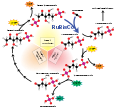 Overview of the Calvin cycle
 -
 Calvin cycle step 1
 -
 Calvin cycle step 2 (doubled)
 -
 Calvin cycle step 3
 -
 Phase of regeneration in the Calvin cycle
 -
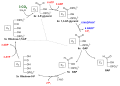 Calvin cycle
 -
 Overall process of the Calvin cycle


.svg)

.svg)


