Graphite-moderated reactor: Difference between revisions
CSV import |
CSV import |
||
| Line 34: | Line 34: | ||
[[Category:Nuclear technology]] | [[Category:Nuclear technology]] | ||
[[Category:Energy technology]] | [[Category:Energy technology]] | ||
<gallery> | |||
File:Nuclear_Reactor_Uranium_Pile_(30502443888).jpg|Graphite-moderated reactor | |||
File:S.R._Sapirie,_Senator_Albert_Gore,_Senator_Lyndon_Johnson,_Dr._John_Swartout,_Looking_at_Model_of_Graghite_Reactor_at_Oak_Ridge_National_Lab._(6964225494).jpg|Model of Graphite Reactor at Oak Ridge National Lab | |||
</gallery> | |||
Latest revision as of 01:38, 18 February 2025
Graphite-moderated reactor is a type of nuclear reactor that uses graphite as a neutron moderator. This type of reactor was first developed in the 1940s and has been used in various forms in many countries around the world.
History[edit]
The first graphite-moderated reactor was the Chicago Pile-1, which was constructed in the United States during the Manhattan Project. This reactor was used to demonstrate the feasibility of a controlled nuclear chain reaction. Following this, the design was further developed and used in a number of other reactors, including the X-10 Graphite Reactor at Oak Ridge National Laboratory and the Hanford Site's B Reactor.
Design and operation[edit]
In a graphite-moderated reactor, the nuclear fuel (usually uranium or plutonium) is surrounded by blocks of graphite. The graphite acts as a moderator, slowing down the neutrons produced by the nuclear reactions. This increases the likelihood that the neutrons will cause further fissions, sustaining the chain reaction.
The heat generated by the nuclear reactions is used to produce steam, which drives a turbine to generate electricity. The steam is then condensed and returned to the reactor core, completing the cycle.
Advantages and disadvantages[edit]
One of the main advantages of graphite-moderated reactors is their simplicity. The use of graphite as a moderator allows for a simpler and more robust design than other types of reactors. This can make them cheaper to build and operate.
However, graphite-moderated reactors also have a number of disadvantages. One of the main ones is the risk of a nuclear meltdown. If the cooling system fails, the heat generated by the nuclear reactions can cause the graphite to ignite, leading to a catastrophic failure of the reactor.
Another disadvantage is the production of radioactive waste. Like all nuclear reactors, graphite-moderated reactors produce waste that must be carefully managed and disposed of.
Examples[edit]
Examples of graphite-moderated reactors include the RBMK reactors used in the Soviet Union (including the one at Chernobyl), and the Magnox and AGR designs used in the United Kingdom.
See also[edit]
| Energy technology | ||||||||||
|---|---|---|---|---|---|---|---|---|---|---|
This Energy technology related article is a stub.
|
-
 Graphite-moderated reactor
 -
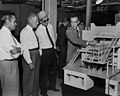 Model of Graphite Reactor at Oak Ridge National Lab
.jpg)
.jpg)
