Epithelial sodium channel: Difference between revisions
CSV import Tags: mobile edit mobile web edit |
CSV import |
||
| Line 32: | Line 32: | ||
[[Category:Electrophysiology]] | [[Category:Electrophysiology]] | ||
{{medicine-stub}} | {{medicine-stub}} | ||
<gallery> | |||
File:ENaC_6BQN_subunit-colored.png|Epithelial sodium channel subunit structure | |||
File:ENaC_membrane_side_eng.svg|Epithelial sodium channel membrane side view | |||
File:Amilorid_-_Amiloride.svg|Amiloride chemical structure | |||
</gallery> | |||
Latest revision as of 03:50, 18 February 2025
Epithelial Sodium Channel (often abbreviated as ENaC) is a type of ion channel found in the epithelium, a layer of cells that line the surfaces of the body. ENaC is responsible for the reabsorption of sodium ions from the lumen into the cells, a process that is crucial for maintaining electrolyte balance and blood pressure in the body.
Structure[edit]
The ENaC is a heterotrimeric complex composed of three subunits: alpha (α), beta (β), and gamma (γ). Each subunit is encoded by a different gene and has a unique structure and function. The α-subunit is essential for the channel's activity, while the β- and γ-subunits modulate its function.
Function[edit]
The primary function of ENaC is to facilitate the transport of sodium ions across the epithelial cells. This process is essential for maintaining the body's fluid and electrolyte balance. In the kidney, ENaC plays a crucial role in the reabsorption of sodium from the urine, thereby regulating the body's sodium balance and blood pressure.
In the lung, ENaC helps to maintain the fluid balance in the airways and alveoli, preventing the accumulation of excess fluid and the development of pulmonary edema.
Regulation[edit]
The activity of ENaC is tightly regulated by various factors, including hormones, neurotransmitters, and changes in the cell's membrane potential. The hormone aldosterone is a key regulator of ENaC. It increases the expression and activity of the channel, leading to increased sodium reabsorption and higher blood pressure.
Clinical significance[edit]
Mutations in the genes encoding the ENaC subunits can lead to various diseases. For example, loss-of-function mutations can cause Pseudohypoaldosteronism type 1, a disorder characterized by salt wasting and low blood pressure. On the other hand, gain-of-function mutations can lead to Liddle's syndrome, a form of inherited hypertension.
In addition, ENaC is a target for several drugs used to treat high blood pressure and cystic fibrosis. For example, amiloride and triamterene are diuretics that block ENaC, reducing sodium reabsorption and lowering blood pressure.
See also[edit]

-
 Epithelial sodium channel subunit structure
 -
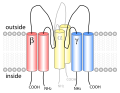 Epithelial sodium channel membrane side view
 -
 Amiloride chemical structure


